

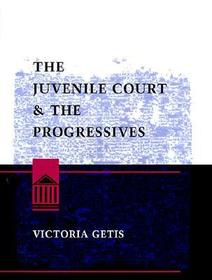
The Juvenile Court and Progressives
- Publisher's listprice GBP 32.00
-
15 288 Ft (14 560 Ft + 5% VAT)
The price is estimated because at the time of ordering we do not know what conversion rates will apply to HUF / product currency when the book arrives. In case HUF is weaker, the price increases slightly, in case HUF is stronger, the price goes lower slightly.
- Discount 10% (cc. 1 529 Ft off)
- Discounted price 13 759 Ft (13 104 Ft + 5% VAT)
Discounted price for customers subscribed to our weekly newsletter.
Subcribe now and take benefit of a favourable price.
Subscribe
Subcribe now and take benefit of a favourable price.
Subscribe
15 288 Ft

Availability
Temporarily out of stock.
Why don't you give exact delivery time?
Delivery time is estimated on our previous experiences. We give estimations only, because we order from outside Hungary, and the delivery time mainly depends on how quickly the publisher supplies the book. Faster or slower deliveries both happen, but we do our best to supply as quickly as possible.
Product details:
- Publisher University of Illinois Press
- Date of Publication 20 July 2000
- Number of Volumes Hardback
- ISBN 9780252025723
- Binding Hardback
- No. of pages232 pages
- Size 229x152x23 mm
- Weight 481 g
- Language English 0
Categories
Long description:
"
Today's troubled juvenile court system has its roots in Progressive-era Chicago, a city one observer described as ""first in violence"" and ""deepest in dirt."" Examining the vision and methods of the original proponents of the Cook County Juvenile Court, Victoria Getis uncovers the court's intrinsic flaws as well as the sources of its debilitation in our own time.
Â
Spearheaded by a group of Chicago women, including Jane Addams, Lucy Flower, and Julia Lathrop, the juvenile court bill was pushed through the legislature by an eclectic coalition of progressive reformers, both women and men. Like many progressive institutions, the court reflected an unswerving faith in the wisdom of the state and in the ability of science to resolve the problems brought on by industrial capitalism.
Â
A hybrid institution combining legal and social welfare functions, the court was not intended to punish youthful lawbreakers but rather to provide guardianship for the vulnerable. In this role, the state was permitted great latitude to intervene in families where it detected a lack of adequate care for children. The court also became a living laboratory, as children in the court became the subjects of research by criminologists, statisticians, educators, state officials, economists, and, above all, practitioners of the new disciplines of sociology and psychology.
Â
The Chicago reformers had worked for large-scale social change, but the means they adopted eventually gave rise to the social sciences, where objectivity was prized above concrete solutions to social problems, and to professional groups that abandoned goals of structural reform. The Juvenile Court and the Progressives argues persuasively that the current impotence of the juvenile court system stems from contradictions that lie at the very heart of progressivism.
Â
"
More
Â
Spearheaded by a group of Chicago women, including Jane Addams, Lucy Flower, and Julia Lathrop, the juvenile court bill was pushed through the legislature by an eclectic coalition of progressive reformers, both women and men. Like many progressive institutions, the court reflected an unswerving faith in the wisdom of the state and in the ability of science to resolve the problems brought on by industrial capitalism.
Â
A hybrid institution combining legal and social welfare functions, the court was not intended to punish youthful lawbreakers but rather to provide guardianship for the vulnerable. In this role, the state was permitted great latitude to intervene in families where it detected a lack of adequate care for children. The court also became a living laboratory, as children in the court became the subjects of research by criminologists, statisticians, educators, state officials, economists, and, above all, practitioners of the new disciplines of sociology and psychology.
Â
The Chicago reformers had worked for large-scale social change, but the means they adopted eventually gave rise to the social sciences, where objectivity was prized above concrete solutions to social problems, and to professional groups that abandoned goals of structural reform. The Juvenile Court and the Progressives argues persuasively that the current impotence of the juvenile court system stems from contradictions that lie at the very heart of progressivism.
Â

