

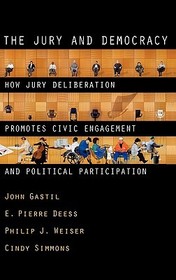
The Jury and Democracy
How Jury Deliberation Promotes Civic Engagement and Political Participation
- Publisher's listprice GBP 72.00
-
32 508 Ft (30 960 Ft + 5% VAT)
The price is estimated because at the time of ordering we do not know what conversion rates will apply to HUF / product currency when the book arrives. In case HUF is weaker, the price increases slightly, in case HUF is stronger, the price goes lower slightly.
- Discount 10% (cc. 3 251 Ft off)
- Discounted price 29 257 Ft (27 864 Ft + 5% VAT)
Subcribe now and take benefit of a favourable price.
Subscribe
32 508 Ft

Availability
printed on demand
Why don't you give exact delivery time?
Delivery time is estimated on our previous experiences. We give estimations only, because we order from outside Hungary, and the delivery time mainly depends on how quickly the publisher supplies the book. Faster or slower deliveries both happen, but we do our best to supply as quickly as possible.
Product details:
- Publisher OUP USA
- Date of Publication 9 December 2010
- ISBN 9780195377309
- Binding Hardback
- No. of pages288 pages
- Size 229x152x20 mm
- Weight 594 g
- Language English 0
Categories
Short description:
Serving on a jury is a powerful experience. The Jury and Democracy is a ground-breaking study that shows how the process of deliberating and reaching a verdict transforms the lives of ordinary citizens. People who serve on juries are more active in civic life and vote more, and the authors examine a number of reasons why this is so. In an era when involved Americans are searching for ways to inspire their fellow citizenry, this book offers a plausible and realistic path for turning passive spectators into active political participants.
MoreLong description:
Alexis de Tocqueville, John Stuart Mill, and the U.S. Supreme Court have all alleged that jury service promotes democratic civic attitudes and political engagement. The Jury and Democracy is the first book to link jury service and political engagement, demonstrating how this institutionalized form of deliberation can contribute to democratic society not only in the United States but also in the many other countries using or experimenting with juries.
The authors look at court and voting records for over thirteen thousand empanelled jurors from across the United States and draw from interviews with thousands more jurors to show that serving on a jury can trigger changes in how citizens view themselves, their peers, and their government. In fact, the study shows that this experience can significantly increase electoral turnout among infrequent voters. Partly as a result of these changing attitudes, jury service also sparks long-term shifts in media use, political action, and community group involvement.
The original findings presented in this research advance modern theories of democracy, deliberation, and the law. Whereas Robert Putnam's Bowling Alone brought attention to informal social networks and voluntary associations, The Jury and Democracy demonstrates the importance of institutionalized, state-sponsored deliberative opportunities for citizens to meet and make legally-binding decisions. Legal debates over the proper use of the jury system have failed to account for the hidden civic costs of circumscribing jury service opportunities. The Jury and Democracy suggests how the jury's power might influence newer, deliberative visions of democracy and promote the transition to democracy in more autocratic societies.
The results produced by Gastil and his colleagues will go a long way to increasing readers' appreciation of juries, and of social science itself.
Table of Contents:
List of Tables and Figures
Acknowledgements
Freedom in Our Hands
Between State and Society
From Jury Box to Ballot Box
Answering the Summons
Citizen Judges
From Courthouse to Community
Civic Attitude Adjustment
Securing the Jury
Political Society and Deliberative Democracy
Further Reading
Methodological Appendix
Endnotes
References
Index
About the Authors

