

- Publisher's listprice GBP 9.99
-
4 510 Ft (4 295 Ft + 5% VAT)
The price is estimated because at the time of ordering we do not know what conversion rates will apply to HUF / product currency when the book arrives. In case HUF is weaker, the price increases slightly, in case HUF is stronger, the price goes lower slightly.
- Discount 10% (cc. 451 Ft off)
- Discounted price 4 059 Ft (3 866 Ft + 5% VAT)
Subcribe now and take benefit of a favourable price.
Subscribe
4 510 Ft

Availability
Estimated delivery time: In stock at the publisher, but not at Prospero's office. Delivery time approx. 3-5 weeks.
Not in stock at Prospero.
Why don't you give exact delivery time?
Delivery time is estimated on our previous experiences. We give estimations only, because we order from outside Hungary, and the delivery time mainly depends on how quickly the publisher supplies the book. Faster or slower deliveries both happen, but we do our best to supply as quickly as possible.
Product details:
- Publisher OUP Oxford
- Date of Publication 23 February 2017
- ISBN 9780198706786
- Binding Paperback
- No. of pages176 pages
- Size 174x114x10 mm
- Weight 149 g
- Language English
- Illustrations 10 black and white illustrations 30
Categories
Short description:
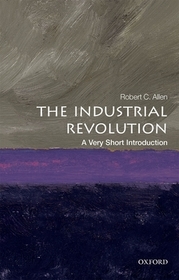
The Industrial Revolution was one of the great, transforming events of world history. Robert C. Allen explains what happened during this period, and why. He asks why the revolution occured in Britain rather than other countries, and looks at the impact of changing technology and business organizations on contemporary social structures.
MoreLong description:
The 'Industrial Revolution' was a pivotal point in British history that occurred between the mid-eighteenth and mid-nineteenth centuries and led to far reaching transformations of society. With the advent of revolutionary manufacturing technology productivity boomed. Machines were used to spin and weave cloth, steam engines were used to provide reliable power, and industry was fed by the construction of the first railways, a great network of arteries feeding the factories. Cities grew as people shifted from agriculture to industry and commerce. Hand in hand with the growth of cities came rising levels of pollution and disease. Many people lost their jobs to the new machinery, whilst working conditions in the factories were grim and pay was low. As the middle classes prospered, social unrest ran through the working classes, and the exploitation of workers led to the growth of trade unions and protest movements.
In this Very Short Introduction, Robert C. Allen analyzes the key features of the Industrial Revolution in Britain, and the spread of industrialization to other countries. He considers the factors that combined to enable industrialization at this time, including Britain's position as a global commercial empire, and discusses the changes in technology and business organization, and their impact on different social classes and groups. Introducing the 'winners' and the 'losers' of the Industrial Revolution, he looks at how the changes were reflected in evolving government policies, and what contribution these made to the economic transformation.
ABOUT THE SERIES: The Very Short Introductions series from Oxford University Press contains hundreds of titles in almost every subject area. These pocket-sized books are the perfect way to get ahead in a new subject quickly. Our expert authors combine facts, analysis, perspective, new ideas, and enthusiasm to make interesting and challenging topics highly readable.
a landmark outline of global economic growth and the British Industrial Revolution in alignment with mainstream economic thinking today.
Table of Contents:
Then and now
The pre-Industral Revolution, 1500-1700
Why the Industrial Revolution was British
The condition of England
Reform and democracy
The spread of the Industrial Revolution abroad
References
Further Reading
Index

