

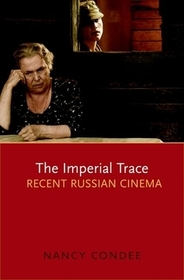
The Imperial Trace
Recent Russian Cinema
- Publisher's listprice GBP 76.00
-
34 314 Ft (32 680 Ft + 5% VAT)
The price is estimated because at the time of ordering we do not know what conversion rates will apply to HUF / product currency when the book arrives. In case HUF is weaker, the price increases slightly, in case HUF is stronger, the price goes lower slightly.
- Discount 10% (cc. 3 431 Ft off)
- Discounted price 30 883 Ft (29 412 Ft + 5% VAT)
Subcribe now and take benefit of a favourable price.
Subscribe
34 314 Ft

Availability
printed on demand
Why don't you give exact delivery time?
Delivery time is estimated on our previous experiences. We give estimations only, because we order from outside Hungary, and the delivery time mainly depends on how quickly the publisher supplies the book. Faster or slower deliveries both happen, but we do our best to supply as quickly as possible.
Product details:
- Publisher OUP USA
- Date of Publication 8 October 2009
- ISBN 9780195366761
- Binding Hardback
- No. of pages360 pages
- Size 236x155x22 mm
- Weight 567 g
- Language English
- Illustrations 20 halftones 0
Categories
Long description:
The collapse of the USSR seemed to spell the end of the empire, yet it by no means marked the end of Russia's enduring imperial preoccupations, extending over four and a half centuries since the reign of Ivan IV. Is there such a thing as an imperial trace in Russia's contemporary culture? Condee argues that we cannot make sense of contemporary Russian culture without accounting for its imperial legacy and mapping out the terms of such an analysis. She turns to the instance of contemporary cinema to focus this line of inquiry. Within film (and implicitly other cultural fields as well) do we limit our accounting to narrative evidence-Chechen wars at the periphery, historical costume dramas of court life-or could an imperial trace be sought in other, more embedded ways, in the manner and structure or representation, the conditions of productions, the recurrent preoccupations of its leading filmmakers, the ways in which collective belonging is figured or disfigured? This book organizes these questions around the work of Russia's internationally ranked auteurs of the late Soviet and post-Soviet period: Kira Muratova, Vadim Abdrashitov, Nikita Mikhalkov, Aleksei German, and Aleksandr Sokurov.
The Imperial Trace is hands down the most thought-provoking book that I have read in quite some time. It is as well (and wittily) written as it is thoroughly researched and skillfully argued, no mean feat given the complexity of the ideas therein. This superb book is essential reading for anyone interested in nations and empire and their cultural manifestations, in Russian cultural politics, and in late Soviet and contemporary Russian film.
Table of Contents:
List of Illustrations
Acknowledgements
Introduction: Custodian of the Empire
Cine-Amnesia: How Russia Forgot to Go to the Movies
Mikhalkov: European but Not Western
Muratova: The Zoological Imperium
Abdrashitov-Mindadze: A Comuunity of Somnambulants
Sokurov: Shuffling Off the Imperial Coil
German: Forensics in the Dynastic Capital
Balabanov: The Metropole's Death Drive
Postscript
References
Index

