

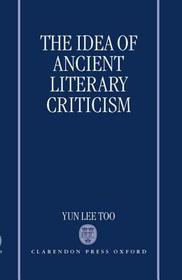
The Idea of Ancient Literary Criticism
- Publisher's listprice GBP 150.00
-
67 725 Ft (64 500 Ft + 5% VAT)
The price is estimated because at the time of ordering we do not know what conversion rates will apply to HUF / product currency when the book arrives. In case HUF is weaker, the price increases slightly, in case HUF is stronger, the price goes lower slightly.
- Discount 10% (cc. 6 773 Ft off)
- Discounted price 60 953 Ft (58 050 Ft + 5% VAT)
Subcribe now and take benefit of a favourable price.
Subscribe
67 725 Ft

Availability
printed on demand
Why don't you give exact delivery time?
Delivery time is estimated on our previous experiences. We give estimations only, because we order from outside Hungary, and the delivery time mainly depends on how quickly the publisher supplies the book. Faster or slower deliveries both happen, but we do our best to supply as quickly as possible.
Product details:
- Publisher OUP Oxford
- Date of Publication 11 February 1999
- ISBN 9780198150763
- Binding Hardback
- No. of pages336 pages
- Size 224x146x24 mm
- Weight 550 g
- Language English 0
Categories
Short description:
This book traces ancient literary criticism from its origins in archaic Greek poetry through to the earlier Christian era. In response to the question `what was ancient literary criticism?' the author argues that when Greek and Roman authors discuss what and how to read in works, they are attempting to create and maintain the political community and its identity.
MoreLong description:
Yun Lee Too offers a sustained reading of the social function of the body of texts we identify as 'ancient literary criticism' with major implications for how we understand this discourse and also modern criticism and literary theory. The author argues that when Greek and Roman authors discuss what and how to read in works, they are attempting to create and maintain the political community and its identity by regulating the languages available to it. Literary criticism is a process of discrimination between competing discourses, serving as a strategy by which certain forms of speech or writing may be pronounced legitimate at the expense of others. The volume traces ancient criticism from its origins in archaic Greek poetry through to the early Christian era. As well as reading the familiar texts of ancient criticism - Plato's Republic, Aristotle's Poetics, [Longinus] On the Sublime, amongst others - it shows how ancient law, history, and rhetoric participate in the critical process.
This is a stimulating contribution to a topic that is drawing fresh attention in many quarters and will be indispensable for libraries.

