

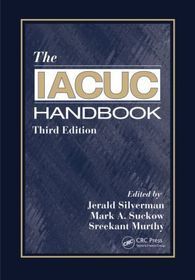
The IACUC Handbook
-
GET 10% OFF
- Publisher's listprice GBP 94.99
-
42 887 Ft (40 845 Ft + 5% VAT)
The price is estimated because at the time of ordering we do not know what conversion rates will apply to HUF / product currency when the book arrives. In case HUF is weaker, the price increases slightly, in case HUF is stronger, the price goes lower slightly.
- Discount 10% (cc. 4 289 Ft off)
- Discounted price 38 599 Ft (36 761 Ft + 5% VAT)
38 599 Ft

Availability
Out of print
Why don't you give exact delivery time?
Delivery time is estimated on our previous experiences. We give estimations only, because we order from outside Hungary, and the delivery time mainly depends on how quickly the publisher supplies the book. Faster or slower deliveries both happen, but we do our best to supply as quickly as possible.
Product details:
- Edition number 3, New edition
- Publisher CRC Press
- Date of Publication 20 May 2014
- ISBN 9781466555648
- Binding Hardback
- No. of pages827 pages
- Size 254x178 mm
- Weight 1660 g
- Language English
- Illustrations 15 Tables, black & white 0
Categories
Short description:
As biomedical research continues to grow, the role and impact of the Institutional Animal Care and Use Committee (IACUC) has increased in scope and complexity. The IACUC Handbook has become "the Bible" for individuals when the time comes for them to serve on their institutions’ IACUC. It provides a foundation for understanding and implementing the many and varied responsibilities of this committee. This third edition comprehensively addresses the significant changes in the pertinent regulatory environment and interpretation of applicable federal laws, regulations, and policies.
MoreLong description:
Ever since its establishment by USDA regulation in the mid-1980s, the Institutional Animal Care and Use Committee (IACUC) has evolved as the premier instrument of animal welfare oversight within research institutions in the United States. As biomedical research continuously grows, the role and impact of the IACUC has increased in scope and complexity. The IACUC Handbook has become "the Bible" for individuals when the time comes for them to serve on their institution’s IACUC. It provides a foundation for understanding and implementing the many and varied responsibilities of this committee.
This Third Edition comprehensively addresses the significant changes in the pertinent regulatory environment and interpretation of applicable federal laws, regulations, and policies. It provides multiple references and commentary on the new edition of the Guide for the Care and Use of Laboratory Animals, the new AVMA Guidelines for the Euthanasia of Animals: 2013 Edition, and the Office of Laboratory Animal Welfare’s Frequently Asked Questions. The Third Edition also features an updated survey of IACUC practices from institutions around the United States, offering wisdom gained from their experience. In addition, it includes a chapter that provides an international perspective on how animal welfare reviews can function in other countries.
"The IACUC Handbook is the best all-in-one source for information relevant to the operation of an IACUC. I like that it implicitly recognizes that all institutions do things differently; hence the surveys following many of the discussions. These are essential benchmarks for us, relieving us of hours of research. I estimate that the number of questions that this book doesn’t address for us is probably well below 5 percent. The current editors have done an astounding job putting together the third edition. It’s come a long way since the first edition (which itself was incredibly useful). I wouldn’t change anything."
- Michael C. Kessler, Director of Regulatory Affairs, Institutional Animal Care and Use Committee (IACUC), University of Pittsburgh
"Similar to the earlier two editions, the 3rd edition of The IACUC Handbook continues the excellent tradition of providing guidance for IACUCs and administrators of animal care and use programs. The editors have done a great job of putting together a group of industry experts to provide advice on how to handle several key features of the laws and regulations that are currently in place. The key feature to me as a reader is the Q&A format of the book that makes it very user friendly, even for readers that are not subject matter experts in the regulations. Overall, in my opinion the new edition…is a very valuable and timely resource for all institutions that have an animal care program and the authors should be commended for taking on this huge task to provide guidance to the industry."
—Jeetendra Eswaraka, DVM, PhD, Amgen, Thousand Oaks, California, in Laboratory Animal Practitioner
"While the first and second editions examine rules, regulations, and guidelines relevant to the United States, this edition also includes a new chapter examining the regulation of animal research in Europe and the European Union. Considering the globalization of today’s world and increasing international collaborations, this chapter is an important addition…. The volume would be useful on the shelf of anyone involved with an animal use program…. Members of the laboratory animal science community must continually respond to changes in order to maintain a high-quality program of animal care. This reference will make that task a little easier."
—Nancy Johnston, DVM, DACLAM, Assistant Director, Laboratory Animal Resource Center, Indiana University School of Medicine, in Laboratory Animal Science Professional
"This handbook provides a comprehensive collection of best practices; all of which are compliant with the federal guidelines and requirements. The sections labeled "regulatory" have been reviewed by staff at NIH Office of Laboratory Animal Welfare (OLAW) and USDA APHIS/Animal Care (AC) for consistency and compliance with the PHS Policy and the USDA Animal Welfare Act Regulations (AWAR).
The best practices presented were developed by conscientious IACUCs and research teams from academia, industry, the private and public sectors, and institutions of various sizes. Answers to a series of operational, policy, and management questions are first addressed from the perspective of the applicable regulatory language, followed by opinions from knowledgeable and experienced professionals in the field, and in some cases ultimately followed by responses to informal surveys on selected institutional policies and practices.
Every effort has been made to apply correct interpretations within the context of the specific issues being discussed. …
For the experienced reader and novice alike, this book provides a wealth of useful information and insight into the collective experience and wisdom of the numerous expert editors and authors. Both NIH/OLAW and APHIS/AC commend the authors and editors for their outstanding efforts and for moving the biomedical research community forward in its formulation of best practices and commonly accepted professional guidance in this complex arena."
—From the Introduction by
Dr. Patricia A. Brown, Director of the Office of Laboratory Animal Welfare
Dr. Chester A. Gipson, Deputy Administrator USDA/APHIS/Animal Care
Table of Contents:
Introduction. Origins of the IACUC. Circumstances Requiring an IACUC. Creation of an IACUC. Reporting Lines of the IACUC. General Composition of the IACUC and Specific Roles of the IACUC Members. Frequency and Conduct of Regular IACUC Meetings. General Format of IACUC Protocol Forms. Submission and Maintenance of IACUC Protocols. General Concepts of Protocol Review. Amending IACUC Protocols. Continuing Review of Protocols. Justification for the Use of Animals. Justification of the Number of Animals to Be Used. Animal Acquisition and Disposition. Animal Housing, Use Sites, and Transportation. Pain and Distress. Euthanasia. Surgery. Antigens, Antibodies, and Blood Collection. Occupational Health and Safety. Personnel Training. Confidential and Proprietary Information. General Concepts of the Program Review and Facility Inspection. Inspection of Animal Housing Areas. Inspection of Individual Laboratories. Inspection of Surgery Areas. Assessment of Veterinary Care. Laboratory Animal Enrichment. Animal Mistreatment and Protocol Noncompliance. Postapproval Monitoring. The European Ethical Review Framework: Collaborative Issues. Index.
More
