

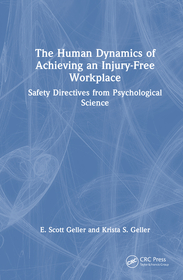
The Human Dynamics of Achieving an Injury-Free Workplace
Safety Directives from Psychological Science
-
GET 10% OFF
- Publisher's listprice GBP 86.99
-
39 275 Ft (37 405 Ft + 5% VAT)
The price is estimated because at the time of ordering we do not know what conversion rates will apply to HUF / product currency when the book arrives. In case HUF is weaker, the price increases slightly, in case HUF is stronger, the price goes lower slightly.
- Discount 10% (cc. 3 928 Ft off)
- Discounted price 35 348 Ft (33 665 Ft + 5% VAT)
35 348 Ft

Availability
Not yet published.
Why don't you give exact delivery time?
Delivery time is estimated on our previous experiences. We give estimations only, because we order from outside Hungary, and the delivery time mainly depends on how quickly the publisher supplies the book. Faster or slower deliveries both happen, but we do our best to supply as quickly as possible.
Product details:
- Edition number 1
- Publisher CRC Press
- Date of Publication 18 August 2026
- ISBN 9781041283171
- Binding Hardback
- No. of pages150 pages
- Size 234x156 mm
- Language English
- Illustrations 46 Illustrations, black & white; 46 Halftones, black & white 700
Categories
Short description:
The Human Dynamics of Achieving an Injury-Free Workplace: Safety Directives from Psychological Science is for safety professionals, managers, supervisors, team leaders, and anyone responsible for workplace safety and health.
MoreLong description:
Creating an injury-free workplace demands more than policies and procedures since it requires the engagement of every employee to actively care for their own safety and that of their colleagues. This research-based, teaching and learning workbook addresses the critical human dynamics that determine whether safety and health initiatives succeed or fail. Drawing from decades of psychological science, the authors present a systematic approach to building an actively-caring-for-people (AC4P) work culture that transforms safety from a compliance-driven requirement into an interdependent shared commitment.
This teaching/learning resource provides the scientific foundation and practical guidance necessary to achieve lasting safety improvements through interpersonal human dynamics. It contains ten distinct safety objectives, each supported by six evidence-based behavioral directives that readers can immediately implement in their workplace. These directives span multiple domains of psychological science, from behavioral principles of reinforcement and feedback to humanistic concepts of empathy and systems thinking. Each chapter includes explanatory text, practical illustrations, thought-provoking discussion questions, and relevant research references, covering essential topics such as behavior-based safety coaching, incident analysis, social influence strategies, stress management, and the cultivation of a Total Safety Culture. Readers will gain the knowledge and tools needed to optimize both individual and interpersonal dynamics for occupational health and safety.
The Human Dynamics of Achieving an Injury-Free Workplace: Safety Directives from Psychological Science is for safety professionals, managers, supervisors, team leaders, and anyone responsible for workplace safety and health. It is equally valuable for safety committees, training facilitators conducting workshops, and individual practitioners seeking to enhance their understanding of safety-related psychology.
MoreTable of Contents:
0. Introduction and Acknowledgements. 1. Safety Objective 1: Appreciate the Complexity of Human Nature. 2. Safety Objective 2: Apply Consequences to Motivate OHS Behavior. 3. Safety Objective 3: Inspire Empowerment and Self-Motivation for OHS. 4. Safety Objective 4: Conduct Optimal Analyses of Close Calls, Injuries, and Fatalities. 5. Safety Objective 5: Apply Social Influence Principles to Enhance OHS Engagement. 6. Safety Objective 6: Apply Interpersonal Coaching to Improve OHS Behavior. 7. Safety Objective 7: Achieve Synergy with Interdependence and Systems Thinking. 8. Safety Objective 8: Apply Humanism to Make BBS More Effective. 9. Safety Objective 9: Nurture a Healthy OHS Mindset within Yourself and Others. 10. Safety Objective 10: Cultivate and Sustain a Total Safety Culture.
More
