

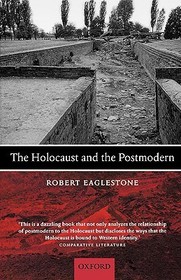
The Holocaust and the Postmodern
- Publisher's listprice GBP 46.49
-
20 990 Ft (19 990 Ft + 5% VAT)
The price is estimated because at the time of ordering we do not know what conversion rates will apply to HUF / product currency when the book arrives. In case HUF is weaker, the price increases slightly, in case HUF is stronger, the price goes lower slightly.
- Discount 10% (cc. 2 099 Ft off)
- Discounted price 18 891 Ft (17 991 Ft + 5% VAT)
Subcribe now and take benefit of a favourable price.
Subscribe
20 990 Ft

Availability
printed on demand
Why don't you give exact delivery time?
Delivery time is estimated on our previous experiences. We give estimations only, because we order from outside Hungary, and the delivery time mainly depends on how quickly the publisher supplies the book. Faster or slower deliveries both happen, but we do our best to supply as quickly as possible.
Product details:
- Publisher OUP Oxford
- Date of Publication 28 February 2008
- ISBN 9780199239375
- Binding Paperback
- No. of pages368 pages
- Size 211x138x22 mm
- Weight 467 g
- Language English 0
Categories
Short description:
Robert Eaglestone argues that postmodernism is a response to the Holocaust. He offers a range of new perspectives, including new ways of looking at testimony and at recent Holocaust fiction; explores controversies in Holocaust history; looks at the importance of the Holocaust for recent philosophy; and asks what the Holocaust means for reason, ethics, and for being human.
MoreLong description:
Robert Eaglestone argues that postmodernism, especially understood in the light of the work of Emmanuel Levinas and Jacques Derrida, is a response to the Holocaust. This way of thinking offers new perspectives on Holocaust testimony, literature, historiography, and post-Holocaust philosophy. While postmodernism is often derided for being either playful and superficial or obscure and elitist, Eaglestone argues and demonstrates its commitment both to the past and to ethics.
Dealing with Holocaust testimony, including the work of Primo Levi and Eli Wiesel, with the memoirs of 'second generation' survivors and with recent Holocaust literature, including Anne Michael's Fugitive Pieces, Jonathan Safran Foer's Everything is Illuminated and the false memoir of Benjamin Wilkomirski, The Holocaust and the Postmodern proposes a new way of reading both Holocaust testimony and Holocaust fiction. Through an exploration of Holocaust historiography, the book offers a new approach to debates over truth and memory. Eaglestone argues for the central importance of the Holocaust in understanding the work of Emmanuel Levinas and Jacques Derrida, and goes on to explore what the Holocaust means for rationality, ethics, and for the idea of what it is to be human. Weaving together theory and practice, testimony, literature, history, philosophy, and Holocaust studies, this interdisciplinary book is the first to explore in detail the significance of the Holocaust for postmodernism, and the significance of postmodernism for understanding the Holocaust.
The breadth of topics covered, coupled with the author's erudition, makes The Holocaust and the Postmodern an invaluable resource for any course on the Holocaust.
Table of Contents:
Reading and the Holocaust
'Not read and consumed in the same way as other books': Identification and the Genre of Testimony
Traces of Experience: The Texts of Testimony
'Faithful and doubtful, near and far': Memory, Postmemory, and Identity
Holocaust Reading: Memory and Identification in Holocaust Fiction 1990-2003
Holocaust Metahistories
Against Historicism: History, Memory, and Truth
'Are Footnotes Less Barbaric?': History, Memory, and the Truth of the Holocaust in the Work of Saul Friedländer
' What Constitutes a Historical Explanation?': Metahistory and the Limits of Historical Explanation in the Goldhagen/Browning Controversy
The Metahistory of Denial: The Irving/Lipstadt Libel Case and Holocaust Denial
The Trace of the Holocaust
Inexhaustible Meaning, Inextinguishable Voices: Levinas and the Holocaust
Cinders of Philosophy, Philosophy of Cinders: Derrida and the Trace of the Holocaust
The Limits of Understanding: Perpetrator Philosophy and Philosophical Histories
The Postmodern, the Holocaust, and the Limits of the Human

