

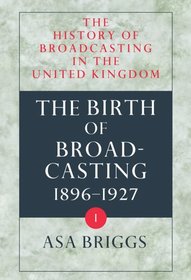
The History of Broadcasting in the United Kingdom: Volume I: The Birth of Broadcasting
- Publisher's listprice GBP 75.00
-
33 862 Ft (32 250 Ft + 5% VAT)
The price is estimated because at the time of ordering we do not know what conversion rates will apply to HUF / product currency when the book arrives. In case HUF is weaker, the price increases slightly, in case HUF is stronger, the price goes lower slightly.
- Discount 10% (cc. 3 386 Ft off)
- Discounted price 30 476 Ft (29 025 Ft + 5% VAT)
Subcribe now and take benefit of a favourable price.
Subscribe
33 862 Ft

Availability
printed on demand
Why don't you give exact delivery time?
Delivery time is estimated on our previous experiences. We give estimations only, because we order from outside Hungary, and the delivery time mainly depends on how quickly the publisher supplies the book. Faster or slower deliveries both happen, but we do our best to supply as quickly as possible.
Product details:
- Edition number and title :Volume I: The Birth of Broadcasting
- Publisher OUP Oxford
- Date of Publication 23 March 1995
- ISBN 9780192129260
- Binding Hardback
- No. of pages434 pages
- Size 223x141x28 mm
- Weight 668 g
- Language English
- Illustrations 20 pp black and white plates, numerous illustrations 0
Categories
Short description:
This is the first of a five-volume history of Broadcasting in the United Kingdom. The Birth of Broadcasting covers early amateur experiments in wireless telephony in America and in England, the pioneer days at Writtle in Essex and elsewhere, and the coming of organized broadcasting and its rapid growth during the first four years of the BBC's existence as a private Company before it became a public Corporation in January 1927. Briggs also considers the impact of wireless on society, and he has much to say about personalities and programmes as well as Corporation policies.
MoreLong description:
This is the first part of a five-volume history of broadcasting in the UK. Together the volumes give an authoritative account of the rise of broadcasting in this country. Though naturally largely concerned with the BBC it does give a general history of broadcasting, not simply an institutional history of the BBC.
The Birth of Broadcasting covers early amateur experiments in wireless telephony in America and in England, the pioneer days at Writtle in Essex and elsewhere, and the coming of organized broadcasting and its rapid growth during the first four years of the BBC's existence as a private Company before it became a public Corporation in January 1927. Briggs describes how and why the Company was formed, the scope of its activities and the reasons which led to its conversion from a business enterprise into a national institution.
The issues raised between 1923 and 1927 remain pertinent today. The hard bargaining between the Post Office, private wireless interests, and the emergent British Broadcsting Company is discussed in illuminating details, together with the remarkable opposition with which the Company had to contend in its early days. Many sections of the opposition, including a powerful section of the press, seemed able to conceive of broadcasting only as competing with their own interests, never as complementing or enlarging them. One of the main themes of this volume is that of the gradual forging of the instruments of public control, and particular attention is paid to the Crawford Report (1926) from which the Corporation arose. During this period all the characteristics of the Corporation first appeared - particularly its reputation for publc service and impartiality.
Briggs also examines the background of wireless as an invention and considers its impact on society. He has much to say about personalities and programmes as well as policies.

