

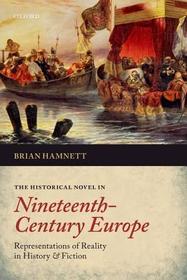
The Historical Novel in Nineteenth-Century Europe
Representations of Reality in History and Fiction
- Publisher's listprice GBP 55.00
-
24 832 Ft (23 650 Ft + 5% VAT)
The price is estimated because at the time of ordering we do not know what conversion rates will apply to HUF / product currency when the book arrives. In case HUF is weaker, the price increases slightly, in case HUF is stronger, the price goes lower slightly.
- Discount 10% (cc. 2 483 Ft off)
- Discounted price 22 349 Ft (21 285 Ft + 5% VAT)
Subcribe now and take benefit of a favourable price.
Subscribe
24 832 Ft

Availability
printed on demand
Why don't you give exact delivery time?
Delivery time is estimated on our previous experiences. We give estimations only, because we order from outside Hungary, and the delivery time mainly depends on how quickly the publisher supplies the book. Faster or slower deliveries both happen, but we do our best to supply as quickly as possible.
Product details:
- Publisher OUP Oxford
- Date of Publication 9 April 2015
- ISBN 9780198732419
- Binding Paperback
- No. of pages342 pages
- Size 231x152x18 mm
- Weight 516 g
- Language English 0
Categories
Short description:
Brian Hamnett examines key historical novels by Scott, Balzac, Manzoni, Dickens, Eliot, Flaubert, Fontane, Galdós, and Tolstoy, revealing the contradictions inherent in this form of fiction and exploring the challenges writers encountered in attempting to represent a reality that linked past and present.
MoreLong description:
Even at the height of its popularity in the early nineteenth century the historical novel faced criticism at many levels. After its predominance in the 1810s and 1820s writers and historians shunned it as a travesty of their respective disciplines. Even so, the historical novel has frequently attracted a wide-ranging public right up to the present day. Brian Hamnett examines key novels, by authors including Scott, Balzac, Manzoni, Dickens, Eliot, Flaubert, Fontane, Galdós, and Tolstoy, revealing the contradictions inherent in this form of fiction and exposing the challenges writers faced in attempting to represent a reality that linked past and present. He argues that the historical novel in the nineteenth century was a common European phenomenon with considerable interconnection of themes and periods. Accordingly, the book ranges from the British Isles and France through the Germanic territories, Italy and Spain, to the Russian Empire, identifying the different objectives and phases of the historical novel. Although historical novels did appear in the two previous centuries, the form came to maturity in the nineteenth century, a consequence of the developing nature of history as a discipline distinct from literature and nhilosophy, and the increasing primacy of the novel for writers and the reading public. Yet, the frontiers between history and literature remained blurred, and the two disciplines continued to influence one another as each sought a faithful representation of human experience.
MoreTable of Contents:
ACKNOWLEDGEMENTS
INTRODUCTION
PART ONE THE HISTORICAL NOVEL AS GENRE AND PROBLEM: AN ANALYTICAL AND CRITICAL EXAMINATION
An Exploration of the Categories: History, Narrative, the Novel and Romance
History and Fiction: The Trials of Separation and Reunion
The German Sturm und Drang, Historical Drama, and Early Romantic Fiction
Scottish Flowering: Turbulence or Enlightenment
Romanticism and the Historical Novel
The Historians' Response to the Historical Novel
History and Invention in the Italian Question
PART TWO INTERNAL CONTRADICTIONS AND UNSTABLE FORM: A COMPARATIVE STUDY OF THE HISTORICAL NOVEL'S DILEMMA
The Historical Novel at mid-Century Crisis?
Is there a Way out? Two Experiments in Myth and History
Galdós and the Novel of Spanish National Identity
The Struggle for Identity and Purpose in the Russian Historical Novel: From Pushkin to Tolstoy
The German Historical Novel
Modernism and Beyond
FICTITIOUS HISTORIES
SOURCES AND BIBLIOGRAPHY

