

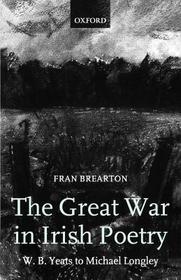
The Great War in Irish Poetry
W. B. Yeats to Michael Longley
- Publisher's listprice GBP 56.00
-
25 284 Ft (24 080 Ft + 5% VAT)
The price is estimated because at the time of ordering we do not know what conversion rates will apply to HUF / product currency when the book arrives. In case HUF is weaker, the price increases slightly, in case HUF is stronger, the price goes lower slightly.
- Discount 10% (cc. 2 528 Ft off)
- Discounted price 22 756 Ft (21 672 Ft + 5% VAT)
Subcribe now and take benefit of a favourable price.
Subscribe
25 284 Ft

Availability
printed on demand
Why don't you give exact delivery time?
Delivery time is estimated on our previous experiences. We give estimations only, because we order from outside Hungary, and the delivery time mainly depends on how quickly the publisher supplies the book. Faster or slower deliveries both happen, but we do our best to supply as quickly as possible.
Product details:
- Publisher OUP Oxford
- Date of Publication 6 February 2003
- ISBN 9780199261383
- Binding Paperback
- No. of pages328 pages
- Size 216x137x18 mm
- Weight 379 g
- Language English 0
Categories
Short description:
This book explores the historical background to Irish participation in the Great War, and the ways in which issues raised in 1914-18 still reverberate in contemporary Northern Ireland. The complications of Irish politics are such that Irish memory of the Great War has often been repressed. Nevertheless, Irish writers throughout the century have been preoccupied with the events and images of the Great War. The work of the Irish poets discussed here - from W. B. Yeats and Ireland's soldier-poets through to Seamus Heaney and contemporary Northern Irish writing - challenges reductive versions of history, and of the literary canon, in relation to Ireland and the First World War.
MoreLong description:
The Great War in Irish Poetry explores the impact of the First World War on the work of W. B. Yeats, Robert Graves, and Louis MacNeice in the period 1914-45, and on three contemporary Northern Irish poets, Derek Mahon, Seamus Heaney, and Michael Longley. Its concern is to place their work, and memory of the Great War, in the context of Irish politics and culture in the twentieth century. The historical background to Irish involvement in the Great War is explained, as are the ways in which issues raised in 1912-20 still reverberate in the politics of remembrance in Northern Ireland, particularly through such events as the Home Rule cause, the loss of the Titanic, the Battle of the Somme, the Easter Rising.
While the Great War is perceived as central to English culture, and its literature holds a privileged position in the English literary canon, the centrality of the Great War to Irish writing has seldom been recognised. This book shows first, that despite complications in Irish domestic politics which led to the repression of memory of the Great War, Irish poets have been drawn throughout the century to the events and images of 1914-18. This engagement is particularly true of those writing in the 'troubled' Northern Ireland of the last thirty years. The second main concern is the extent to which recognition of the importance of the Great War in Irish writing has itself become a casualty of competing versions of the literary canon.
Brearton's well-researched and intelligently argued book makes a convincing argument about the engagement of Irish poets with this defining event of the twentieth century.
Table of Contents:
Part I: The art of the war
Ireland in the Great War: literature, history, culture
W. B. Yeats: creation from conflict
Robert Graves: resisting the canon
Louis MacNeice: between two wars
Part II: The northern renascence
Northern Ireland and the politics of remembrance
A dying art: Derek Mahon's solving ambiguity
The end of art: Seamus Heaney's apology for poetry
Michael Longley: poet in no man's land
Bibliography
Index

