

- Publisher's listprice GBP 9.99
-
4 510 Ft (4 295 Ft + 5% VAT)
The price is estimated because at the time of ordering we do not know what conversion rates will apply to HUF / product currency when the book arrives. In case HUF is weaker, the price increases slightly, in case HUF is stronger, the price goes lower slightly.
- Discount 10% (cc. 451 Ft off)
- Discounted price 4 059 Ft (3 866 Ft + 5% VAT)
Subcribe now and take benefit of a favourable price.
Subscribe
4 510 Ft

Availability
Estimated delivery time: In stock at the publisher, but not at Prospero's office. Delivery time approx. 3-5 weeks.
Not in stock at Prospero.
Why don't you give exact delivery time?
Delivery time is estimated on our previous experiences. We give estimations only, because we order from outside Hungary, and the delivery time mainly depends on how quickly the publisher supplies the book. Faster or slower deliveries both happen, but we do our best to supply as quickly as possible.
Product details:
- Publisher OUP USA
- Date of Publication 24 April 2008
- ISBN 9780195326345
- Binding Paperback
- No. of pages160 pages
- Size 173x112x10 mm
- Weight 136 g
- Language English
- Illustrations 10 maps & halftones 0
Categories
Short description:
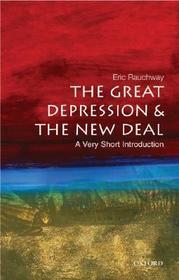
In the middle of the great, global twentieth-century crisis, the Great Depression forced the United States to adopt policies at odds with its political traditions. This very short introduction to that crisis and those policies provides readers with a summary of the global impact and effect of the economic contraction and the American reaction.
MoreLong description:
The New Deal shaped our nation's politics for decades, and was seen by many as tantamount to the "American Way" itself. Now, in this superb compact history, Eric Rauchway offers an informed account of the New Deal and the Great Depression, illuminating its successes and failures.
Rauchway first describes how the roots of the Great Depression lay in America's post-war economic policies--described as "laissez-faire with a vengeance"--which in effect isolated our nation from the world economy just when the world needed the United States most. He shows how the magnitude of the resulting economic upheaval, and the ineffectiveness of the old ways of dealing with financial hardships, set the stage for Roosevelt's vigorous (and sometimes unconstitutional) Depression-fighting policies. Indeed, Rauchway stresses that the New Deal only makes sense as a response to this global economic disaster.
The book examines a key sampling of New Deal programs, ranging from the National Recovery Agency and the Securities and Exchange Commission, to the Public Works Administration and Social Security, revealing why some worked and others did not.
In the end, Rauchway concludes, it was the coming of World War II that finally generated the political will to spend the massive amounts of public money needed to put Americans back to work. And only the Cold War saw the full implementation of New Deal policies abroad--including the United Nations, the World Bank, and the International Monetary Fund.
Today we can look back at the New Deal and, for the first time, see its full complexity. Rauchway captures this whole in a remarkably short space, making this book an ideal introduction to one of the great policy revolutions in history.
ABOUT THE SERIES: The Very Short Introductions series from Oxford University Press contains hundreds of titles in almost every subject area. These pocket-sized books are the perfect way to get ahead in a new subject quickly. Our expert authors combine facts, analysis, perspective, new ideas, and enthusiasm to make interesting and challenging topics highly readable.
Table of Contents:
Introduction
The World Crisis
Before the New Deal
How did we get caught?"
The New Deal vs. the Constitution
FDR, His Friends, and His Enemies
The New Deal that Lasted
Working for the United States of America
The New Deal in War and Peace
The New Deal Legacy

