

- Publisher's listprice GBP 122.50
-
58 524 Ft (55 737 Ft + 5% VAT)
The price is estimated because at the time of ordering we do not know what conversion rates will apply to HUF / product currency when the book arrives. In case HUF is weaker, the price increases slightly, in case HUF is stronger, the price goes lower slightly.
- Discount 10% (cc. 5 852 Ft off)
- Discounted price 52 671 Ft (50 163 Ft + 5% VAT)
Subcribe now and take benefit of a favourable price.
Subscribe
58 524 Ft

Availability
Uncertain availability. Please turn to our customer service.
Why don't you give exact delivery time?
Delivery time is estimated on our previous experiences. We give estimations only, because we order from outside Hungary, and the delivery time mainly depends on how quickly the publisher supplies the book. Faster or slower deliveries both happen, but we do our best to supply as quickly as possible.
Product details:
- Publisher OUP USA
- Date of Publication 15 March 2018
- ISBN 9780190674502
- Binding Hardback
- No. of pages224 pages
- Size 157x239x22 mm
- Weight 499 g
- Language English 0
Categories
Short description:
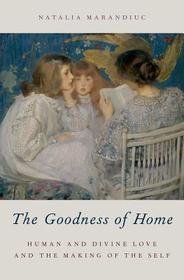
In this wide-ranging contribution to Christian theological anthropology, Natalia Marandiuc offers a constructive theological argument for the function of love attachments as sources of subjectivity and enablers of human freedom. Human loves and the love of God are portrayed here as co-creating the self and situating human subjectivity in a relational "home."
MoreLong description:
In a modern world characterized by a precarious job market, class inequality, and a global migrant crisis, Natalia Marandiuc asks the question: How does home affect one's identity? In this wide-ranging contribution to Christian theological anthropology, Marandiuc argues that love attachments function as sources of subjectivity and enablers of human freedom. Human loves and the love of God are co-creators of the self and they situate human subjectivity in a relational home. Paradoxically, the depth of human belonging, dependence, is thus directly proportional to the strength of human agency, independence.
Building upon S?ren Kierkegaard, research in the neuroscience of attachment theory, and contemporary constructions of the self, The Goodness of Home makes original contributions to several central issues in contemporary Christian theological anthropology. Love is understood as central to the building of subjectivity, which is seen as an intersection of desire and need. For Marandiuc, the self is a complex process of becoming rather than a static entity with essentialist features. She looks at human difference in terms of the formation of particular subjectivities through particular loves. Ultimately, she depicts human love as interwoven with the infinite streams of divine love, forming a sacramental site for God's presence, and playing a constitutive role in the making of the self.
The Goodness of Home is an important work that makes a significant contribution to theological anthropology, the doctrine of creation and theological ethics.
Table of Contents:
Acknowledgements
I. Why Home? A Preamble about the Argument's Theological Significance
II. Human Double Embeddedness: Frameworks of Meaning and Significant Relationships
III. Theological Implications from Attachment Theory
IV. Human Difference and Particular Subjectivity
V. Human and Divine Love Co-Creating the Self
VI. The Goodness of Home: Attachment as Anthropological and Pneumatological Middle Space
Bibliography

