

- Publisher's listprice GBP 142.50
-
68 079 Ft (64 837 Ft + 5% VAT)
The price is estimated because at the time of ordering we do not know what conversion rates will apply to HUF / product currency when the book arrives. In case HUF is weaker, the price increases slightly, in case HUF is stronger, the price goes lower slightly.
- Discount 10% (cc. 6 808 Ft off)
- Discounted price 61 271 Ft (58 353 Ft + 5% VAT)
Subcribe now and take benefit of a favourable price.
Subscribe
68 079 Ft

Availability
printed on demand
Why don't you give exact delivery time?
Delivery time is estimated on our previous experiences. We give estimations only, because we order from outside Hungary, and the delivery time mainly depends on how quickly the publisher supplies the book. Faster or slower deliveries both happen, but we do our best to supply as quickly as possible.
Product details:
- Publisher Clarendon Press
- Date of Publication 11 April 1991
- ISBN 9780198117834
- Binding Hardback
- No. of pages208 pages
- Size 224x145x17 mm
- Weight 381 g
- Language English 0
Categories
Long description:
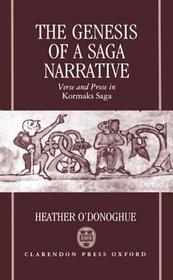
The origins of many of the Icelandic sagas have long been the subject of critical speculation and controversy. This book demonstrates that an investigation of the relationship between verse and prose in saga narrative can be used to reconstruct how Icelandic sagas were composed; to this end it provides a detailed analysis of Kormaks saga, whose hero Kormakr is one of the most celebrated of Icelandic poets. Over sixty of his passionate, cryptic skaldic stanzas are quoted in the saga, and the way they and the saga prose are fitted together reveals that Kormaks saga, far from being a seamless narrative of either pre-Christian oral tradition or later medieval fiction, is in fact a patchwork of different kinds of literary materials. This book offers an original and productive way of understanding not only the compositional method and distinctive aesthetic qualities of Kormaks saga, but also the genesis of many other Icelandic saga narratives.
This study is undoubtedly an important contribution to our understanding of saga poetics.

