

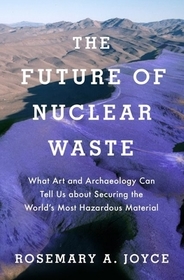
The Future of Nuclear Waste
What Art and Archaeology Can Tell Us about Securing the World's Most Hazardous Material
- Publisher's listprice GBP 22.99
-
10 983 Ft (10 460 Ft + 5% VAT)
The price is estimated because at the time of ordering we do not know what conversion rates will apply to HUF / product currency when the book arrives. In case HUF is weaker, the price increases slightly, in case HUF is stronger, the price goes lower slightly.
- Discount 10% (cc. 1 098 Ft off)
- Discounted price 9 885 Ft (9 414 Ft + 5% VAT)
Subcribe now and take benefit of a favourable price.
Subscribe
10 983 Ft

Availability
cancelled
Why don't you give exact delivery time?
Delivery time is estimated on our previous experiences. We give estimations only, because we order from outside Hungary, and the delivery time mainly depends on how quickly the publisher supplies the book. Faster or slower deliveries both happen, but we do our best to supply as quickly as possible.
Product details:
- Publisher OUP USA
- Date of Publication 1 March 2020
- ISBN 9780190888145
- Binding Paperback
- No. of pages292 pages
- Size 235x156 mm
- Language English 0
Categories
Short description:
In this book, a contemporary archaeologist critically examines designs experts advising the US government suggested to mark nuclear waste sites and prevent their excavation thousands of years into the future: to build either an artificial ruin, or install a landscape scale artwork; and explores why planners thought they would work.
MoreLong description:
How can nations ensure that buried nuclear waste goes undisturbed for thousands of years? The United States government tried to solve this problem with the help of experts they identified in communication, materials science, and futurism. From the perspective of a contemporary archaeologist, The Future of Nuclear Waste looks at what these experts suggested, and what the government endorsed: designs for a modern monument, an artificial ruin, a purpose-built
archaeological site that would escape future exploration. One design, selected for development, argued that because specific archaeological sites and objects (among them Stonehenge, Serpent Mound, the Rosetta Stone, and rock art) made long ago have endured and are seen as significant today, contemporary
engineers could build monuments that would be equally effective in conveying messages that last even longer. An alternative proposal, which government planners set aside, was rooted in the idea that universal archetypes of design arouse similar human emotions in all times and places. Both proposals used common sense, assuming that human reactions and understandings are relatively predictable.
Employing an anthropology of common sense, Rosemary Joyce explores why people chosen for their expertise relied on generalizations contradicted by the actual history of preservation and interpretation of archaeological sites and the closest analogues to archetype-based designs, which are the large scale installations produced in the Land Art movement. The book reveals the underlying imagination shared by the experts, government planners, and artists, in which the American West is an empty space
available for projects like these. It counters this with the dissenting voices of indigenous scholars and activists who document the presence on these nuclear landscapes of Native American people. The result is an eye-opening and unique demonstration of how a deep understanding of the remote past
informs critical debates about the present.
Table of Contents:
Preface
Acknowledgements
Introduction
Chapter 1: Stonehenge in Nevada
Interlude 1: Forbidding Blocks
Chapter 2: Serpent Mound
Interlude 2: Menacing Earthworks
Chapter 3: Rosetta Stones and Cuneiform Tablets
Interlude 3: Spikes Bursting Through Grid
Chapter 4: Indelible Messages from Newgrange to Kakadu Park
Interlude 4: Australian Art in Nuclear Landscapes
Chapter 5: Enduring Meaning
Conclusion: Stories About Endings
References Cited

