

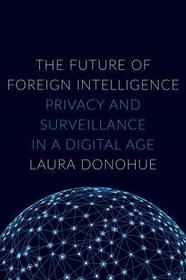
The Future of Foreign Intelligence
Privacy and Surveillance in a Digital Age
Series: Inalienable Rights;
- Publisher's listprice GBP 28.99
-
13 088 Ft (12 465 Ft + 5% VAT)
The price is estimated because at the time of ordering we do not know what conversion rates will apply to HUF / product currency when the book arrives. In case HUF is weaker, the price increases slightly, in case HUF is stronger, the price goes lower slightly.
- Discount 20% (cc. 2 618 Ft off)
- Discounted price 10 471 Ft (9 972 Ft + 5% VAT)
- Discount is valid until: 30 June 2026
Subcribe now and take benefit of a favourable price.
Subscribe
13 088 Ft

Availability
Estimated delivery time: In stock at the publisher, but not at Prospero's office. Delivery time approx. 3-5 weeks.
Not in stock at Prospero.
Why don't you give exact delivery time?
Delivery time is estimated on our previous experiences. We give estimations only, because we order from outside Hungary, and the delivery time mainly depends on how quickly the publisher supplies the book. Faster or slower deliveries both happen, but we do our best to supply as quickly as possible.
Product details:
- Publisher OUP USA
- Date of Publication 10 March 2016
- ISBN 9780190235383
- Binding Hardback
- No. of pages204 pages
- Size 211x145x25 mm
- Weight 340 g
- Language English 0
Categories
Short description:
Renowned national security law scholar Laura Donohue traces the evolution of privacy law in the digital age, and pairs that account with a history of the growth of the national security state's intelligence apparatus over the last two decades.
MoreLong description:
Since the Revolutionary War, America's military and political leaders have recognized that U.S. national security depends upon the collection of intelligence. Absent information about foreign threats, the thinking went, the country and its citizens stood in great peril. To address this, the Courts and Congress have historically given the President broad leeway to obtain foreign intelligence. But in order to find information about an individual in the United States, the executive branch had to demonstrate that the person was an agent of a foreign power. Today, that barrier no longer exists. The intelligence community now collects massive amounts of data and then looks for potential threats to the United States.
As renowned national security law scholar Laura K. Donohue explains in The Future of Foreign Intelligence, the internet and new technologies such as biometric identification systems have not changed our lives in countless ways. But they have also led to a very worrying transformation. The amount and types of information that the government can obtain has radically expanded, and information that is being collected for foreign intelligence purposes is now being used for domestic criminal prosecution. Traditionally, the Courts have allowed exceptions to the Fourth Amendment rule barring illegal search and seizure on national security grounds. But the new ways in which we collect intelligence are swallowing the rule altogether. Just as alarming, the ever-weaker standards that mark foreign intelligence collection are now being used domestically-and the convergence between these realms threatens individual liberty.
Donohue traces the evolution of foreign intelligence law and pairs that account with the progress of Fourth Amendment jurisprudence. She argues that the programmatic surveillance that the National Security Agency conducts amounts to a general warrant-the prevention of which was the point of introducing the Fourth Amendment. The expansion of foreign intelligence surveillance - leant momentum by significant advances in technology, the Global War on Terror, and the emphasis on securing the homeland - now threatens to consume protections essential to privacy, which is a necessary component of a healthy democracy. Donohue offers an agenda for reining in the national security state's expansive reach, primarily through Congressional statutory reform that will force the executive and judicial branches to take privacy seriously, even as it provides for the continued collection of intelligence central to U.S. national security. Both alarming and penetrating, this is essential reading for anyone interested in the future of foreign intelligence and privacy in the United States.
Table of Contents:
TK
More
