

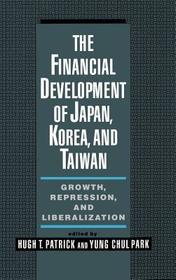
The Financial Development of Japan, Korea, and Taiwan
Growth, Repression, and Liberalization
- Publisher's listprice GBP 150.00
-
67 725 Ft (64 500 Ft + 5% VAT)
The price is estimated because at the time of ordering we do not know what conversion rates will apply to HUF / product currency when the book arrives. In case HUF is weaker, the price increases slightly, in case HUF is stronger, the price goes lower slightly.
- Discount 10% (cc. 6 773 Ft off)
- Discounted price 60 953 Ft (58 050 Ft + 5% VAT)
Subcribe now and take benefit of a favourable price.
Subscribe
67 725 Ft

Availability
printed on demand
Why don't you give exact delivery time?
Delivery time is estimated on our previous experiences. We give estimations only, because we order from outside Hungary, and the delivery time mainly depends on how quickly the publisher supplies the book. Faster or slower deliveries both happen, but we do our best to supply as quickly as possible.
Product details:
- Publisher OUP USA
- Date of Publication 8 December 1994
- ISBN 9780195087666
- Binding Hardback
- No. of pages400 pages
- Size 241x162x33 mm
- Weight 684 g
- Language English
- Illustrations line figures, tables 0
Categories
Short description:
This book analyses the evolution of the financial systems in Japan, Korea, and Taiwan in relation to their emergence as world economic powers.
MoreLong description:
This path-breaking comparative study of the economies of Japan, Korea, and Taiwan analyses the evolution of the financial systems of each country in relation to their last four decades of dynamic economic growth. Each country study is addressed in two chapters, the first covering macroeconomic aspects of the financial system and the second chapter focusing on commercial banking. The analysis shows how financial development has occurred in two distinct phases. Initially interest rates were regulated to remain below market levels, entry of new financial institutions was restricted, financial markets were segmented, and domestic finance was insulated from world financial markets. The second phase has seen a steady, if sometimes slow, removal of these restrictions. This liberalization has meant regulation now focuses on prudential measures for system safety while financial resources are increasingly allocated through the marketplace. The evaluation of the financial development of Japan, Korea and Taiwan provides significant insights for economists and policymakers. In particular, there are many lessons for less developed markets and transforming socialist economics.
More
