

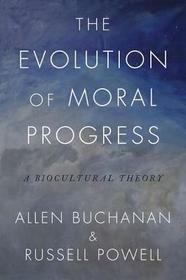
The Evolution of Moral Progress
A Biocultural Theory
- Publisher's listprice GBP 40.49
-
19 344 Ft (18 422 Ft + 5% VAT)
The price is estimated because at the time of ordering we do not know what conversion rates will apply to HUF / product currency when the book arrives. In case HUF is weaker, the price increases slightly, in case HUF is stronger, the price goes lower slightly.
- Discount 10% (cc. 1 934 Ft off)
- Discounted price 17 409 Ft (16 580 Ft + 5% VAT)
Subcribe now and take benefit of a favourable price.
Subscribe
19 344 Ft

Availability
Estimated delivery time: Expected time of arrival: end of January 2026.
Not in stock at Prospero.
Why don't you give exact delivery time?
Delivery time is estimated on our previous experiences. We give estimations only, because we order from outside Hungary, and the delivery time mainly depends on how quickly the publisher supplies the book. Faster or slower deliveries both happen, but we do our best to supply as quickly as possible.
Product details:
- Publisher OUP USA
- Date of Publication 30 August 2018
- ISBN 9780190868413
- Binding Hardback
- No. of pages440 pages
- Size 165x236x38 mm
- Weight 699 g
- Language English 0
Categories
Short description:
Steven Pinker has said that one of the most important questions humans can ask of themselves is whether moral progress has occurred or is likely to occur. Buchanan and Powell here address that question, in order to provide the first naturalistic, empirically-informed and analytically sophisticated theory of moral progress--explaining the capacities in the human brain that allow for it, the role of the environment, and how contingent and fragile moral progress can be.
MoreLong description:
In The Evolution of Moral Progress, Allen Buchanan and Russell Powell resurrect the project of explaining moral progress. They avoid the errors of earlier attempts by drawing on a wide range of disciplines including moral and political philosophy, evolutionary biology, evolutionary psychology, anthropology, history, and sociology.
Their focus is on one especially important type of moral progress: gains in inclusivity. They develop a framework to explain progress in inclusivity to also illuminate moral regression--the return to exclusivist and "tribalistic" moral beliefs and attitudes. Buchanan and Powell argue those tribalistic moral responses are not hard-wired by evolution in human nature. Rather, human beings have an evolved "adaptively plastic" capacity for both inclusion and exclusion, depending on environmental conditions. Moral progress in the dimension of inclusivity is possible, but only to the extent that human beings can create environments conducive to extending moral standing to all human beings and even to some animals. Buchanan and Powell take biological evolution seriously, but with a critical eye, while simultaneously recognizing the crucial role of culture in creating environments in which moral progress can occur. The book avoids both biological and cultural determinism. Unlike earlier theories of moral progress, their theory provides a naturalistic account that is grounded in the best empirical work, and unlike earlier theories it does not present moral progress as inevitable or as occurring in definite stages; but rather it recognizes the highly contingent and fragile character of moral improvement.
Highly recommended.
Table of Contents:
Introduction: Why a Theory of Moral Progress is Needed
Part One: What is Moral Progress?
Chapter 1: A Typology of Moral Progress
Chapter 2: Contemporary Accounts of Moral Progress
Chapter 3: A Pluralistic, Dynamic Conception of Moral Progress
Part Two: Evolution and the Possibility of Moral Progress
Chapter 4: Is Evolved Human Nature an Obstacle to Moral Progress?
Chapter 5: The Inclusivist Anomaly and the Limits of Evolutionary Explanation
Chapter 6: Toward a Naturalistic Theory of Inclusivist Moral Progress
Chapter 7: Naturalizing Moral Regression: A Biocultural Account
Chapter 8: De-Moralization and the Evolution of Invalid Moral Norms
Part Three: The Path Traveled and the Way Forward
Chapter 9: Improvements in Moral Understanding and the Human Rights Movement
Chapter 10: Human Rights Naturalized
Chapter 11: Biomedical Moral Enhancement and Moral Progress
Conclusion: The Future of Human Morality
Appendix: Topics for Further Research

