

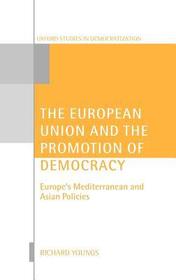
The European Union and the Promotion of Democracy
Europe's Mediterranean and Asian Policies
Series: Oxford Studies in Democratization;
- Publisher's listprice GBP 115.00
-
51 922 Ft (49 450 Ft + 5% VAT)
The price is estimated because at the time of ordering we do not know what conversion rates will apply to HUF / product currency when the book arrives. In case HUF is weaker, the price increases slightly, in case HUF is stronger, the price goes lower slightly.
- Discount 10% (cc. 5 192 Ft off)
- Discounted price 46 730 Ft (44 505 Ft + 5% VAT)
Subcribe now and take benefit of a favourable price.
Subscribe
51 922 Ft

Availability
printed on demand
Why don't you give exact delivery time?
Delivery time is estimated on our previous experiences. We give estimations only, because we order from outside Hungary, and the delivery time mainly depends on how quickly the publisher supplies the book. Faster or slower deliveries both happen, but we do our best to supply as quickly as possible.
Product details:
- Publisher OUP Oxford
- Date of Publication 3 January 2002
- ISBN 9780199242122
- Binding Hardback
- No. of pages280 pages
- Size 243x164x20 mm
- Weight 549 g
- Language English 0
Categories
Short description:
This book assesses European Union policies aimed at encouraging democratization in East Asia and the Mediterranean, addressing theoretical debates over the international dimensions of political change and the EU's characteristics as an international actor. The factors driving and inhibiting European democracy promotion policies are explored, and the EU's distinctive 'bottom-up' approach to political change is outlined. The book notes an evolution in European policies, while arguing that the EU has failed to develop a fully comprehensive and coherent democracy promotion strategy.
MoreLong description:
This book assesses European Union policies aimed at encouraging democratization in East Asia and the North African and Middle Eastern States within the Euro-Mediterranean Partnership - these two regions being the source of some of the strongest conceptual challenges to 'Western' liberal democracy since the end of the cold war. The book addresses theoretical debates over the international dimensions of political change and the EU's characteristics as an international actor. The factors both driving and inhibiting European democracy promotion policies are explored. The book outlines the EU's distinctive bottom-up philosophy, aimed at constructing the socio-economic and ideational foundations for political liberalization, but argues that the EU has in practice failed to develop a fully comprehensive and coherent democracy promotion strategy.
It will be of most interest to those with a good grounding in EU external policy-making, for whom this will be a key reference; it is also of considerable value to those concerned with the impact of norms and interests on policy-making in the post-Cold War era.
Table of Contents:
Democracy Promotion in the 1990s: Agency, Motives, and Strategy
EU Democracy Promotion Instruments: Evolution and Shortcomings
The EU and the Mediterranean
The EU and Algeria
The EU and East Asia
The EU and China
Conclusion: Conceptualizing the EU as a Promoter of Democracy

