

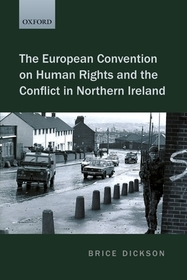
The European Convention on Human Rights and the Conflict in Northern Ireland
- Publisher's listprice GBP 56.00
-
25 284 Ft (24 080 Ft + 5% VAT)
The price is estimated because at the time of ordering we do not know what conversion rates will apply to HUF / product currency when the book arrives. In case HUF is weaker, the price increases slightly, in case HUF is stronger, the price goes lower slightly.
- Discount 10% (cc. 2 528 Ft off)
- Discounted price 22 756 Ft (21 672 Ft + 5% VAT)
Subcribe now and take benefit of a favourable price.
Subscribe
25 284 Ft

Availability
printed on demand
Why don't you give exact delivery time?
Delivery time is estimated on our previous experiences. We give estimations only, because we order from outside Hungary, and the delivery time mainly depends on how quickly the publisher supplies the book. Faster or slower deliveries both happen, but we do our best to supply as quickly as possible.
Product details:
- Publisher OUP Oxford
- Date of Publication 15 March 2012
- ISBN 9780199652341
- Binding Paperback
- No. of pages488 pages
- Size 236x160x27 mm
- Weight 746 g
- Language English 0
Categories
Short description:
This book charts the role played by the European Convention on Human Rights during the conflict in Northern Ireland from 1968 to the present day. It offers a systematic case-study of the Convention's capacity to protect human rights in a society wracked by terrorism and political conflict.
MoreLong description:
This book provides the first comprehensive account of the role played by the European Convention on Human Rights during the conflict in Northern Ireland from 1968. Brice Dickson studies the effectiveness of the Convention in protecting human rights in a society wracked by terrorism and deep political conflict, detailing the numerous applications lodged at Strasbourg relating to the conflict and considering how they were dealt with by the enforcement bodies. The book illustrates the limitations inherent in the Convention system but also demonstrates how the European Commission and Court of Human Rights gradually developed a more interventionist approach to the applications emanating from Northern Ireland. In turn this allowed the Convention to become a more secure guarantor of basic rights and freedoms during times of extreme civil unrest and political turmoil elsewhere in Europe.
The topics examined include the right to life, the right not to be ill-treated, the right to liberty, the right to a fair trial, the right to a private life, the right to freedom of belief, the right to freedom of expression, the right to freedom of assembly, and the right not to be discriminated against. The book argues that, while eventually the European Court did use the applications from Northern Ireland to establish important human rights principles, their development was slow and arduous and some gaps in protection still remain. The book illustrates the limits of the European Convention as a tool for protecting human rights in times of crisis.
Table of Contents:
Preface
Introduction
The Background to the Conflict and the Rights Discourse
Early Fumblings with the Convention
Internment and Restrictions on Movement
Powers of Arrest
Detention Pending Charge or Trial
The Right Not to be Ill-treated
The Right to a Fair Trial
The Right to Life
The Right to a Private and Family Life
Freedom of Expression, Belief, and Assembly
Freedom from Discrimination
The Final Picture
Appendix: Applications lodged in Strasbourg relating to the conflict in Northern Ireland

