

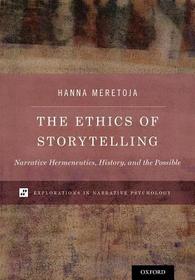
The Ethics of Storytelling
Narrative Hermeneutics, History, and the Possible
Series: Explorations in Narrative Psychology;
- Publisher's listprice GBP 117.50
-
53 051 Ft (50 525 Ft + 5% VAT)
The price is estimated because at the time of ordering we do not know what conversion rates will apply to HUF / product currency when the book arrives. In case HUF is weaker, the price increases slightly, in case HUF is stronger, the price goes lower slightly.
- Discount 10% (cc. 5 305 Ft off)
- Discounted price 47 746 Ft (45 473 Ft + 5% VAT)
Subcribe now and take benefit of a favourable price.
Subscribe
53 051 Ft

Availability
printed on demand
Why don't you give exact delivery time?
Delivery time is estimated on our previous experiences. We give estimations only, because we order from outside Hungary, and the delivery time mainly depends on how quickly the publisher supplies the book. Faster or slower deliveries both happen, but we do our best to supply as quickly as possible.
Product details:
- Publisher OUP USA
- Date of Publication 1 February 2018
- ISBN 9780190649364
- Binding Hardback
- No. of pages368 pages
- Size 236x155x27 mm
- Weight 612 g
- Language English 0
Categories
Short description:
Hanna Meretoja's The Ethics of Storytelling: Narrative Hermeneutics, History, and the Possible develops a nuanced framework for exploring the ethical complexity of the roles narratives play in our lives. Focusing on how narratives enlarge and diminish the spaces of possibilities in which we act, think, and re-imagine the world together with others, this book proposes a theoretical-analytical framework for engaging with both the ethical potential and risks of storytelling.
MoreLong description:
Against the backdrop of the polarized debate on the ethical significance of storytelling, Hanna Meretoja's The Ethics of Storytelling: Narrative Hermeneutics, History, and the Possible develops a nuanced framework for exploring the ethical complexity of the roles narratives play in our lives. Focusing on how narratives enlarge and diminish the spaces of possibilities in which we act, think, and re-imagine the world together with others, this book proposes a theoretical-analytical framework for engaging with both the ethical potential and risks of storytelling. Further, it elaborates a narrative hermeneutics that treats narratives as culturally mediated practices of (re)interpreting experiences and articulates how narratives can be oppressive, empowering, or both. It also argues that the relationship between narrative unconscious and narrative imagination shapes our sense of the possible.
In her book, Meretoja develops a hermeneutic narrative ethics that differentiates between six dimensions of the ethical potential of storytelling: the power of narratives to cultivate our sense of the possible; to contribute to individual and cultural self-understanding; to enable understanding other lives non-subsumptively in their singularity; to transform the narrative in-betweens that bind people together; to develop our perspective-awareness and capacity for perspective-taking; and to function as a form of ethical inquiry. This book addresses our implication in violent histories and argues that it is as dialogic storytellers, fundamentally vulnerable and dependent on one another, that we become who we are: both as individuals and communities.
The Ethics of Storytelling seamlessly incorporates narrative ethics, literary narrative studies, narrative psychology, narrative philosophy, and cultural memory studies. It contributes to contemporary interdisciplinary narrative studies by developing narrative hermeneutics as a philosophically rigorous, historically sensitive, and analytically subtle approach to the ethical stakes of the debate on the narrative dimension of human existence.
Certainly one of the most interesting new literary publications in 2018. In particular, how Meretoja draws on both older theory and research results from cognitively oriented literary studies and brings them into dialogue with each other proves to be profitable. Last but not least, the book is particularly reader-friendly due to its clear structure and the numbering of its individual thoughts.
Table of Contents:
Chapter 1 Introduction: Towards an Ethics of Storytelling
Chapter 2 Narrative Hermeneutics
Chapter 3 Storytelling and Ethics
Chapter 4 The Uses and Abuses of Narrative for Life: Julia Franck's Die Mittagsfrau
Chapter 5 Narrative Ethics of Implication: Günte Grass and Historical Imagination
Chapter 6 Narrative Dynamics, Perspective-Taking, and Engagement: Jonathan Littell's Les Bienveillantes
Chapter 7 Transforming Narrative In-Betweens: Dialogic Storytelling in David Grossman's To the End of the Land and Falling Out of Time
Chapter 8 Conclusion: Struggles Over the Possible

