

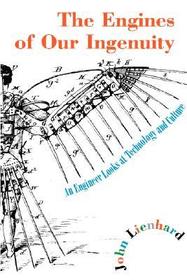
The Engines of Our Ingenuity
An Engineer Looks at Technology and Culture
- Publisher's listprice GBP 18.99
-
9 072 Ft (8 640 Ft + 5% VAT)
The price is estimated because at the time of ordering we do not know what conversion rates will apply to HUF / product currency when the book arrives. In case HUF is weaker, the price increases slightly, in case HUF is stronger, the price goes lower slightly.
- Discount 10% (cc. 907 Ft off)
- Discounted price 8 165 Ft (7 776 Ft + 5% VAT)
Subcribe now and take benefit of a favourable price.
Subscribe
9 072 Ft

Availability
printed on demand
Why don't you give exact delivery time?
Delivery time is estimated on our previous experiences. We give estimations only, because we order from outside Hungary, and the delivery time mainly depends on how quickly the publisher supplies the book. Faster or slower deliveries both happen, but we do our best to supply as quickly as possible.
Product details:
- Publisher OUP USA
- Date of Publication 10 April 2003
- ISBN 9780195167313
- Binding Paperback
- No. of pages272 pages
- Size 151x240x18 mm
- Weight 386 g
- Language English
- Illustrations 45 halftones & 23 line illus. 0
Categories
Short description:
This book explores the nature of creativity in engineering and technology, and how it relates to creativity in art or science. Lienhard has for ten years done a twice-weekly radio show, carried on about 35 NPR stations, consisting of 3-minute essays on technology. He uses the substance of selected segments of his radio program to create a continuous narrative presenting his insights on technological creativity. This book has the same title as his radio program, to further draw the attention of his one million listeners.
MoreLong description:
Millions of people have listened to John H. Lienhard's radio program "The Engines of Our Ingenuity." In this fascinating book, Lienhard gathers his reflections on the nature of technology, culture, and human inventiveness. The book brims with insightful observations. Lienhard writes that the history of technology is a history of us--we are the machines we create. Thus farming dramatically changed the rhythms of human life and redirected history. War seldom fuels invention--radar, jets, and the digital computer all emerged before World War II began. And the medieval Church was a driving force behind the growth of Western technology--Cistercian monasteries were virtual factories, whose water wheels cut wood, forged iron, and crushed olives. Lienhard illustrates his themes through inventors, mathematicians, and engineers--with stories of the canoe, the DC-3, the Hoover Dam, the diode, and the sewing machine. We gain new insight as to who we are, through the familiar machines and technologies that are central to our lives.
John Lienhard brings a relentless optimism to his exposition of 'the complex mirroring processes that define technology-driven evolution'.

