

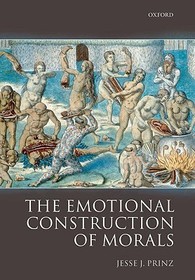
The Emotional Construction of Morals
- Publisher's listprice GBP 99.00
-
44 698 Ft (42 570 Ft + 5% VAT)
The price is estimated because at the time of ordering we do not know what conversion rates will apply to HUF / product currency when the book arrives. In case HUF is weaker, the price increases slightly, in case HUF is stronger, the price goes lower slightly.
- Discount 10% (cc. 4 470 Ft off)
- Discounted price 40 229 Ft (38 313 Ft + 5% VAT)
Subcribe now and take benefit of a favourable price.
Subscribe
44 698 Ft

Availability
printed on demand
Why don't you give exact delivery time?
Delivery time is estimated on our previous experiences. We give estimations only, because we order from outside Hungary, and the delivery time mainly depends on how quickly the publisher supplies the book. Faster or slower deliveries both happen, but we do our best to supply as quickly as possible.
Product details:
- Publisher OUP Oxford
- Date of Publication 22 November 2007
- ISBN 9780199283019
- Binding Hardback
- No. of pages348 pages
- Size 241x163x24 mm
- Weight 674 g
- Language English 0
Categories
Short description:
Jesse Prinz presents a bravura argument for highly controversial claims about morality, which go to the heart of our understanding of ourselves. He argues that moral values are based on emotional responses, and that these are inculcated by culture, not hard-wired through natural selection. These two claims support a form of moral relativism.
MoreLong description:
Jesse Prinz argues that recent work in philosophy, neuroscience, and anthropology supports two radical hypotheses about the nature of morality: moral values are based on emotional responses, and these emotional responses are inculcated by culture, not hard-wired through natural selection.
In the first half of the book, Jesse Prinz defends the hypothesis that morality has an emotional foundation. Evidence from brain imaging, social psychology, and psychopathology suggest that, when we judge something to be right or wrong, we are merely expressing our emotions. Prinz argues that these emotions do not track objective features of reality; rather, the rightness and wrongness of an act consists in the fact that people are disposed to have certain emotions towards it. In the second half of the book, he turns to a defence of moral relativism. Moral facts depend on emotional responses, and emotional responses vary from culture to culture. Prinz surveys the anthropological record to establish moral variation, and he draws on cultural history to show how attitudes toward practices such as cannibalism and marriage change over time. He also criticizes evidence from animal behaviour and child development that has been taken to support the claim that moral attitudes are hard-wired by natural selection. Prinz concludes that there is no single true morality, but he also argues that some moral values are better than others; moral progress is possible.
Throughout the book, Prinz relates his views to contemporary and historical work in philosophical ethics. His views echo themes in the writings of David Hume and Friedrich Nietzsche, but Prinz supports, extends, and revises these classic theories using the resources of cutting-edge cognitive science. The Emotional Construction of Morals will stimulate and challenge anyone who is curious about the nature and origin of moral values
...a good book. Prinz has a roaming, eager mind that is fun to engage with, and his defense of sensibility theory is full of new resources that promise to invigorate the metaethical debate. On almost every page there is something to excite one's interest...
Table of Contents:
Preamble: Naturalism and Hume's Law
Part I. Morality and Emotion
Emotionism
Emotions: Nonmoral and Moral
Sensibility Saved
Against Objectivity
Part II. Constructing Morals
Dining with Cannibals
The Genealogy of Morals
The Limits of Evolutionary Ethics
Moral Progress: Beyond Good and Evil?

