

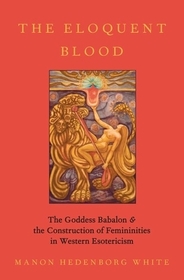
The Eloquent Blood
The Goddess Babalon and the Construction of Femininities in Western Esotericism
Series: Oxford Studies in Western Esotericism;
- Publisher's listprice GBP 122.50
-
55 308 Ft (52 675 Ft + 5% VAT)
The price is estimated because at the time of ordering we do not know what conversion rates will apply to HUF / product currency when the book arrives. In case HUF is weaker, the price increases slightly, in case HUF is stronger, the price goes lower slightly.
- Discount 10% (cc. 5 530 Ft off)
- Discounted price 49 778 Ft (47 408 Ft + 5% VAT)
Subcribe now and take benefit of a favourable price.
Subscribe
55 308 Ft

Availability
printed on demand
Why don't you give exact delivery time?
Delivery time is estimated on our previous experiences. We give estimations only, because we order from outside Hungary, and the delivery time mainly depends on how quickly the publisher supplies the book. Faster or slower deliveries both happen, but we do our best to supply as quickly as possible.
Product details:
- Publisher OUP USA
- Date of Publication 26 February 2020
- ISBN 9780190065027
- Binding Hardback
- No. of pages392 pages
- Size 165x239x33 mm
- Weight 726 g
- Language English 0
Categories
Short description:
The Eloquent Blood focuses on the changing construction of femininity and feminine sexuality in interpretations of the goddess Babalon. A central deity in Thelema, the religion founded by the notorious British occultist Aleister Crowley (1875-1947), Babalon is based on Crowley's favorable reinterpretation of the biblical Whore of Babylon, and is associated with liberated female sexuality and the spiritual ideal of passionate union with existence. Combining research on historical and contemporary Western esotericism with feminist and queer theory, the book sheds light on the ways in which esoteric movements and systems of thought have developed over time in relation to political movements.
MoreLong description:
In the conventional dichotomy of chaste, pure Madonna and libidinous whore, the former has usually been viewed as the ideal form of femininity. However, there is a modern religious movement in which the negative stereotype of the harlot is inverted and exalted. The Eloquent Blood focuses on the changing construction of femininity and feminine sexuality in interpretations of the goddess Babalon. A central deity in Thelema, the religion founded by the notorious British occultist Aleister Crowley (1875-1947), Babalon is based on Crowley's favorable reinterpretation of the biblical Whore of Babylon, and is associated with liberated female sexuality and the spiritual ideal of passionate union with existence.
Analyzing historical and contemporary written sources, qualitative interviews, and ethnographic fieldwork in the Anglo-American esoteric milieu, the study traces interpretations of Babalon from the works of Crowley and some of his key disciples--including the rocket scientist John "Jack" Whiteside Parsons, and the enigmatic British occultist Kenneth Grant--until the present. From the 1990s onwards, this study shows, female and LGBTQ esotericists have challenged historical interpretations of Babalon, drawing on feminist and queer thought and conceptualizing femininity in new ways.
Tracing the trajectory of a particular gendered symbol from the fin-de-siècle until today, Manon Hedenborg White explores the changing role of women in Western esotericism, and shows how evolving constructions of gender have shaped the development of esotericism. Combining research on historical and contemporary Western esotericism with feminist and queer theory, the book sheds new light on the ways in which esoteric movements and systems of thought have developed over time in relation to political movements.
Eloquent Blood is a rich, courageous book, with many layers of concept and debate... A text to be read, considered carefully, and debated by all scholars of modern and contemporary esotericism.
Table of Contents:
Acknowledgements
I. Encountering the Scarlet Goddess
II. Divine Women, Femmes, and Whores: The Theorization of Multiple Femininities
III. The Scarlet Goddess and the Wine of Her Fornications: Crowley, Babalon, and the Femme Fatale 1898-1909
IV. Yielding Peaches and Women with Whips: Babalon, Crowley, and Magical Systematization 1911-1947
V. Her Banner is Unfolded: Babalon and Scarlet Femininities in the Writings of Jack Parsons
VI. Kundalini, Kalas, and Qadeshim: Babalon and Femininity as Other in the Writings of Kenneth Grant
VII. Intermezzo: Contemporary Occultism and Thelema
VIII. "It All Goes in the Cup": Receptivity and Unstable Polarities in the Contemporary Babalon Discourse
IX. Feminist Difference: Babalon and the Hope of an Alternative Femininity
X. Inhabiting the Uninhibited: Babalon, Sexual Politics, and the Liberation of the Desiring Feminine Subject
XI. Possession and Dispossession: Embodiment, Ecstasy, and Erotic Destruction
XII. "Like Fire and Powder": Erotic Destruction and the Eloquent Blood
XIII. Bibliography

