

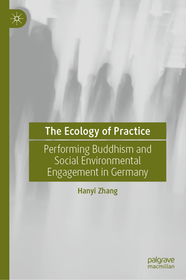
The Ecology of Practice
Performing Buddhism and Social Environmental Engagement in Germany
-
GET 12% OFF
- Publisher's listprice EUR 160.49
-
62 687 Ft (59 702 Ft + 5% VAT)
The price is estimated because at the time of ordering we do not know what conversion rates will apply to HUF / product currency when the book arrives. In case HUF is weaker, the price increases slightly, in case HUF is stronger, the price goes lower slightly.
- Discount 12% (cc. 7 522 Ft off)
- Discounted price 55 165 Ft (52 538 Ft + 5% VAT)
55 165 Ft

Availability
Not yet published.
Why don't you give exact delivery time?
Delivery time is estimated on our previous experiences. We give estimations only, because we order from outside Hungary, and the delivery time mainly depends on how quickly the publisher supplies the book. Faster or slower deliveries both happen, but we do our best to supply as quickly as possible.
Product details:
- Publisher Springer Nature Switzerland
- Date of Publication 24 April 2026
- ISBN 9783032178138
- Binding Hardback
- No. of pages543 pages
- Size 210x148 mm
- Language English
- Illustrations XXI, 543 p. 3 illus. 700
Categories
Long description:
This book offers a well-grounded ethnographic analysis of the ecological practices of Buddhists in Germany, demonstrating how traditional teachings are connected with contemporary environmental engagement. It shows how Buddhist groups, such as the Order of Interbeing, XR Buddhists, or Fo Guang Shan, respond to climate change by turning mindfulness, compassion, and performative rituals into concrete social and ecological action. Key themes include the integration of Buddhist ethics into everyday ecological practices, the transformation of spiritual identity through embodied and symbolic action, and the role of religion in fostering social-ecological change. Drawing on interviews and participant observation, the author analyzes how Buddhist communities adapt their practices to current challenges while generating new forms of ecological spirituality in the process. This volume is particularly significant in the context of global environmental crises, as it shows that religion is not a refuge from the world but a powerful resource for collective transformation. The book fills a gap in the literature by theoretically framing and empirically investigating the previously under-researched field of German-language eco-Buddhism with perspectives from performativity theory and epistemic entanglement. It is an important read for scholars in the fields of religious studies, social and cultural anthropology, environmental ethics, and Buddhist studies, as well as practitioners engaged in interreligous or ecological movements.
MoreTable of Contents:
"
Chapter 1. Introduction.- Chapter 2. Theoretical Framework.- Chapter 3. Case Studies in Germany.- Chapter 4. Cross Case Study Analysis and Conclusion.
" More
