

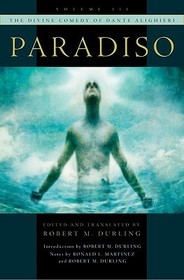
The Divine Comedy of Dante Alighieri
Volume 3: Paradiso
- Publisher's listprice GBP 60.00
-
28 665 Ft (27 300 Ft + 5% VAT)
The price is estimated because at the time of ordering we do not know what conversion rates will apply to HUF / product currency when the book arrives. In case HUF is weaker, the price increases slightly, in case HUF is stronger, the price goes lower slightly.
- Discount 10% (cc. 2 867 Ft off)
- Discounted price 25 799 Ft (24 570 Ft + 5% VAT)
Subcribe now and take benefit of a favourable price.
Subscribe
28 665 Ft

Availability
printed on demand
Why don't you give exact delivery time?
Delivery time is estimated on our previous experiences. We give estimations only, because we order from outside Hungary, and the delivery time mainly depends on how quickly the publisher supplies the book. Faster or slower deliveries both happen, but we do our best to supply as quickly as possible.
Product details:
- Publisher OUP USA
- Date of Publication 3 February 2011
- ISBN 9780195087420
- Binding Hardback
- No. of pages888 pages
- Size 241x167x52 mm
- Weight 1334 g
- Language English
- Illustrations 7 black and white halftone illustrations 0
Categories
Short description:
Pardiso is the third of three volumes of a new edition and translation of Dantes's masterpiece, The Divine Comedy. Similar to volumes I Inferno and II Purgatorio, this translation will be into English prose, emphasizing the literal-vs-phonetic. A newly edited version of the Italian text will be on facing pages and includes fully comprehensive notes with the latest in contemporary scholarship.
MoreLong description:
Robert Durling's much-anticipated translation of the Paradiso, the third and final volume of Dante's Divine Comedy, is available at last. Durling's prose translations of the Inferno and the Purgatorio garnered high praise, and with this superb version of the Paradiso readers can now traverse the entirety of Dante's epic poem of spiritual ascent with the guidance of one of the greatest living Italian-to-English translators.
Reunited with his beloved Beatrice in the Paradiso, the poet-narrator journeys through the heavenly spheres and comes to know "the state of blessed souls after death," the joy that every man can attain with God's grace. As with the previous volumes, the original Italian and its English translation appear on facing pages for language mavens. But every reader will be drawn to Durling's precise and vivid prose, which is perfectly suited to capture Dante's extraordinary range of expression--from the high style of divine revelation to colloquial speech, lyrical interludes, and scornful diatribes against corrupt monks.
This edition boasts several unique features to aid readers. The notes by Durling and Ronald Martinez at the end of each canto not only illuminate the Paradiso, but stress the links among all three volumes of the Commedia, something seldom done in other editions. It also includes several drawings that illustrate Dante's medieval cosmology and a map of the poet's journey through Paradise. Durling's lucid, stage-setting introduction explores the Paradiso's unsurpassed imaginative richness and provides historical, political, biblical, and theological contexts that further enhance the reader's comprehension of the poem's major themes. Finally, the volume includes a unique set of indexes, including Proper Names in the Notes (with rich subheadings concerning themes and rhetorical devices), Passages Cited in the Notes, Words Discussed in the Notes, as well as the customary Index of Proper Names in the Text and Translation.
No reader will be disappointed by this reader-friendly, lovingly rendered new edition, a fitting capstone to Durling's remarkable achievement.
As Durling and Martinez complete their monumental three-volume presentation of Dante's masterpiece, we can sense their triumph and elation, despite their characteristic modesty. This, after all, is the volume with which they can demonstrate the fullness and consistency of Dante's great project, its final approach to what they describe in one footnote as 'a pitch of intensity unique in all literature.' The scholarship, as always, is graceful, comprehensive, and acute, and it surrounds a translation that is so carefully considered and fully realized as to be, at times, quite breathtaking.

