

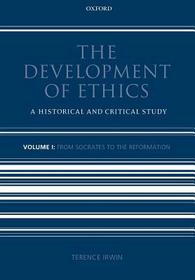
The Development of Ethics: Volume 1
From Socrates to the Reformation
- Publisher's listprice GBP 62.00
-
27 993 Ft (26 660 Ft + 5% VAT)
The price is estimated because at the time of ordering we do not know what conversion rates will apply to HUF / product currency when the book arrives. In case HUF is weaker, the price increases slightly, in case HUF is stronger, the price goes lower slightly.
- Discount 10% (cc. 2 799 Ft off)
- Discounted price 25 194 Ft (23 994 Ft + 5% VAT)
Subcribe now and take benefit of a favourable price.
Subscribe
27 993 Ft

Availability
printed on demand
Why don't you give exact delivery time?
Delivery time is estimated on our previous experiences. We give estimations only, because we order from outside Hungary, and the delivery time mainly depends on how quickly the publisher supplies the book. Faster or slower deliveries both happen, but we do our best to supply as quickly as possible.
Product details:
- Publisher OUP Oxford
- Date of Publication 11 August 2011
- ISBN 9780199693856
- Binding Paperback
- No. of pages842 pages
- Size 245x183x42 mm
- Weight 1242 g
- Language English 0
Categories
Short description:
Terence Irwin presents a historical and critical study of the development of moral philosophy over two thousand years, from ancient Greece to the Renaissance. This is the first volume of a three-part survey of the entire history of Western ethics. Irwin begins here with Socrates, Plato, and Aristotle, and guides the reader through the centuries.
MoreLong description:
The Development of Ethics is a selective historical and critical study of moral philosophy in the Socratic tradition, with special attention to Aristotelian naturalism, its formation, elaboration, criticism, and defence. It discusses the main topics of moral philosophy as they have developed historically, including: the human good, human nature, justice, friendship, and morality; the methods of moral inquiry; the virtues and their connexions; will, freedom, and responsibility; reason and emotion; relativism, subjectivism, and realism; the theological aspect of morality. This volume examines ancient and medieval philosophy up to the sixteenth century; Volumes 2 and 3 will continue the story up to Rawls's Theory of Justice.
The present volume begins with Socrates, the Cyrenaics and Cynics, and Plato, and then offers a fuller account of Aristotle, stressing the systematic naturalism of his position. The Stoic position is compared with the Aristotelian at some length; Epicureans and Sceptics are discussed more briefly. Chapters on early Christianity and on Augustine introduce a fuller examination of Aquinas' revision, elaboration, and defence of Aristotelian naturalism. The volume closes with an account of some criticisms of the Aristotelian outlook by Scotus, Ockham, Machiavelli, and some sixteenth-century Reformers.
The emphasis of the book is not purely descriptive, narrative, or exegetical, but also philosophical. Irwin discusses the comparative merits of different views, the difficulties that they raise, and how some of the difficulties might be resolved. The book tries to present the leading moral philosophers of the past as participants in a rational discussion that is still being carried on, and tries to help the reader to participate in this discussion.
Review from previous edition A remarkable work of scholarship. Very few philosophers could produce a work of such scale and such erudition. Professor Irwin has studied his chosen authors with minute precision, and has read exhaustively in the secondary literature. Sources are conscientiously recorded and ample quotations provided in footnotes. The treatment of controversial issues is always balanced, and the eventual verdicts are always judicious ... This book is a monument of erudition and patience, and gives promise of similar virtues in the forthcoming successor volume.
Table of Contents:
Preface
Abbreviations
Introduction
Socrates
Cyrenaics
Cynics
Plato
Aristotle: Happiness
Aristotle: Nature
Aristotle: Virtue
Aristotle: Virtue and Morality
Scepticism
Epicurus
Stoicism: Action, Passion, and Reason
Stoicism: Virtue and Happiness
Christian Theology and Moral Philosophy
Augustine
Aquinas: Will
Aquinas: Action
Aquinas: Freedom
Aquinas: The Ultimate End
Aquinas: Moral Virtue
Aquinas: Natural Law
Aquinas: Practical Reason and Prudence
Aquinas: The Canon of Virtues
Aquinas: Sin and Grace
Scotus: Will, Freedom, and Reason
Scotus: Virtue and Practical Reason
Ockham
Machiavelli
The Reformation and Scholastic Moral Philosophy
Bibliography
Index

