

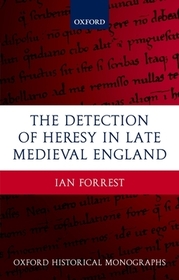
The Detection of Heresy in Late Medieval England
Series: Oxford Historical Monographs;
- Publisher's listprice GBP 195.00
-
88 042 Ft (83 850 Ft + 5% VAT)
The price is estimated because at the time of ordering we do not know what conversion rates will apply to HUF / product currency when the book arrives. In case HUF is weaker, the price increases slightly, in case HUF is stronger, the price goes lower slightly.
- Discount 10% (cc. 8 804 Ft off)
- Discounted price 79 238 Ft (75 465 Ft + 5% VAT)
Subcribe now and take benefit of a favourable price.
Subscribe
88 042 Ft

Availability
printed on demand
Why don't you give exact delivery time?
Delivery time is estimated on our previous experiences. We give estimations only, because we order from outside Hungary, and the delivery time mainly depends on how quickly the publisher supplies the book. Faster or slower deliveries both happen, but we do our best to supply as quickly as possible.
Product details:
- Publisher OUP Oxford
- Date of Publication 20 October 2005
- ISBN 9780199286928
- Binding Hardback
- No. of pages292 pages
- Size 223x146x22 mm
- Weight 503 g
- Language English 0
Categories
Short description:
This is the first scholarly study of inquisition into heresy in medieval England. Heresy was the most feared crime in the medieval moral universe. It was seen as a social disease capable of poisoning the body politic and shattering the unity of the church. Ian Forrest argues that in order to understand who the heretics were, we first need to understand how they were defined in their own day. Successful heresy-detection relied on balancing suspicion against legal standards of evidence, and weighing the safety of the public against the rights of the suspect.
MoreLong description:
Heresy was the most feared crime in the medieval moral universe. It was seen as a social disease capable of poisoning the body politic and shattering the unity of the church. The study of heresy in late medieval England has, to date, focused largely on the heretics. In consequence, we know very little about how this crime was defined by the churchmen who passed authoritative judgement on it.
By examining the drafting, publicizing, and implementing of new laws against heresy in the fourteenth and fifteenth centuries, using published and unpublished judicial records, this book presents the first general study of inquisition in medieval England. In it Ian Forrest argues that because heresy was a problem simultaneously national and local, detection relied upon collaboration between rulers and the ruled. While involvement in detection brought local society into contact with the apparatus of government, uneducated laymen still had to be kept at arm's length, because judgements about heresy were deemed too subtle and important to be left to them. Detection required bishops and inquisitors to balance reported suspicions against canonical proof, and threats to public safety against the rights of the suspect and the deficiencies of human justice.
At present, the character and significance of heresy in late medieval England is the subject of much debate. Ian Forrest believes that this debate has to be informed by a greater awareness of the legal and social contexts within which heresy took on its many real and imagined attributes.
a very good and important book indeed.
Table of Contents:
Note on canon law citations and bishops' registers
Introduction
I: Legislation
Questions of Knowledge and Ignorance
The Investigation of Heresy
The Techniques of Detection
II: Communication
Statutes and the Circulation of Knowledge
The Channels of Propaganda
The Content of Propaganda
III: Implementation
Reporting Heresy
The Social Contours of Heresy-Detection
Conclusion
Bibliography
Index

