

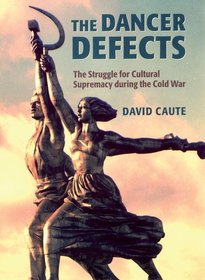
The Dancer Defects
The Struggle for Cultural Supremacy during the Cold War
- Publisher's listprice GBP 75.00
-
33 862 Ft (32 250 Ft + 5% VAT)
The price is estimated because at the time of ordering we do not know what conversion rates will apply to HUF / product currency when the book arrives. In case HUF is weaker, the price increases slightly, in case HUF is stronger, the price goes lower slightly.
- Discount 10% (cc. 3 386 Ft off)
- Discounted price 30 476 Ft (29 025 Ft + 5% VAT)
Subcribe now and take benefit of a favourable price.
Subscribe
33 862 Ft

Availability
printed on demand
Why don't you give exact delivery time?
Delivery time is estimated on our previous experiences. We give estimations only, because we order from outside Hungary, and the delivery time mainly depends on how quickly the publisher supplies the book. Faster or slower deliveries both happen, but we do our best to supply as quickly as possible.
Product details:
- Publisher OUP Oxford
- Date of Publication 4 September 2003
- ISBN 9780199249084
- Binding Hardback
- No. of pages818 pages
- Size 242x164x45 mm
- Weight 1282 g
- Language English
- Illustrations 16 pp halftone plates 0
Categories
Short description:
With the onset of the Cold War, cultural competition flared up between Moscow and the West. It rapidly penetrated theatre, film, music, ballet, painting, and sculpture. Artists such as Miller, Picasso, Eisenstein, Shostakovich, and Stravinsky became involved in this fierce cultural competition through which each of the major Cold War protagonists sought to establish their supremacy.
MoreLong description:
The cultural Cold War between the Soviet Union and the West was without precedent. At the outset of this original and wide-ranging historical survey, David Caute establishes the nature of the extraordinary cultural competition set up post-1945 between Moscow, New York, London and Paris, with the most intimate frontier war staged in the city of Berlin. Using sources in four languages, the author of The Fellow-Travellers and The Great Fear explores the cultural Cold War as it rapidly penetrated theatre, film, classical music, popular music, ballet, painting and sculpture, as well as propaganda by exhibition.
Major figures central to Cold War conflict in the theatre include Brecht, Miller, Sartre, Camus, Havel, Ionesco, Stoppard and Konstantin Simonov, whose inflammatory play, The Russian Question, occupies a chapter of its own based on original archival research. Leading film directors involved included Eisenstein, Romm, Chiarueli, Aleksandrov, Kazan, Tarkovsky and Wajda.
In the field of music, the Soviet Union in the Zhdanov era vigorously condemned 'modernism', 'formalism', and the avant-garde. A chapter is devoted to the intriguing case of Dmitri Shostakovich, and the disputed authenticity of his 'autobiography' Testimony. Meanwhile in the West the Congress for Cultural Freedom was sponsoring the modernist composers most vehemently condemned by Soviet music critics; Stravinsky, Schoenberg, Hindemith among them. Despite constant attempts at repression, the Soviet Party was unable to check the appeal of jazz on the Voice of America, then rock music, to young Russians.
Visits to the West by the Bolshoi and Kirov ballet companines, the pride of the USSR, were fraught with threats of cancellation and the danger of defection. Considering the case of Rudolf Nureyev, Caute pours cold water on overheated speculations about KGB plots to injure him and other defecting dancers.
Turning to painting, where socialist realism prevailed in Russia, and the impressionist heritage was condemned, Caute explores the paradox of Picasso's membership of the French Communist Party. Re-assessing the extent of covert CIA patronage of abstract expressionism (Pollock, De Kooning), Caute finds that the CIA's role has been much exaggerated, likewise the dominance of the New York School.
Caute challenges some recent, one-dimensional, American accounts of 'Cold War culture', which ignore not only the Soviet performance but virtually any cultural activity outside the USA. The West presented its cultural avant-garde as evidence of liberty, even through monochrome canvases and dodecaphonic music appealed only to a minority audience. Soviet artistic standards and teaching levels were exceptionally high, but the fear of freedom and innovation virtually guaranteed the moral defeat which accelerated the collapse of the Soviet Union.
This is a profound study of a vast subject which was, we now see, a vital aspect of the Cold War. One now eagerly awaits the second volume.
Table of Contents:
Introduction: The Culture War
Part I: Marking the Territory
Propaganda Wars and Cultural Treaties
The Gladiatorial Exhibition
Part II: Stage and Screen Wars: Russia and America
Broadway Dead, Says Soviet Critic
The Russian Question - a Russian Play
Soviet Cinema under Stalin
Hollywood: The Red Menace
Witch Hunts: Losey, Kazan, Miller
Soviet Cinema: The New Wave
Part III: Stage and Screen Wars: Europe
Germany Divided: Stage and Screen
Brecht and the Berliner Ensemble
Dirty Hands: The Political Theatre of Sartre and Camus
Squaring the Circle: Ionesco, Beckett, Havel and Stoppard
Andrzej Wajda: Ashes and Diamonds, Marble and Iron
Part IV: Music and Ballet Wars
Classical Music Wars
Shostakovich's Testimony
All that Jazz: Iron Curtain Falls
The Ballet Dancer Defects
Part V: Art Wars
Stalinist Art: The Tractor Driver's Supper
Passports for Paintings: Abstract Impressionism and the CIA
Picasso and Communist France
The Other Russia: Pictures by 'Jackasses'
Conclusion
Bibliography
Notes and References

