

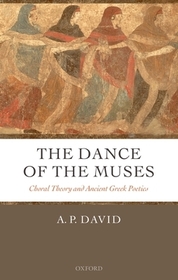
The Dance of the Muses
Choral Theory and Ancient Greek Poetics
- Publisher's listprice GBP 147.50
-
66 596 Ft (63 425 Ft + 5% VAT)
The price is estimated because at the time of ordering we do not know what conversion rates will apply to HUF / product currency when the book arrives. In case HUF is weaker, the price increases slightly, in case HUF is stronger, the price goes lower slightly.
- Discount 10% (cc. 6 660 Ft off)
- Discounted price 59 937 Ft (57 083 Ft + 5% VAT)
Subcribe now and take benefit of a favourable price.
Subscribe
66 596 Ft

Availability
printed on demand
Why don't you give exact delivery time?
Delivery time is estimated on our previous experiences. We give estimations only, because we order from outside Hungary, and the delivery time mainly depends on how quickly the publisher supplies the book. Faster or slower deliveries both happen, but we do our best to supply as quickly as possible.
Product details:
- Publisher OUP Oxford
- Date of Publication 28 September 2006
- ISBN 9780199292400
- Binding Hardback
- No. of pages304 pages
- Size 223x145x21 mm
- Weight 482 g
- Language English 0
Categories
Short description:
In this book David develops a revolutionary approach to Greek poetics, which takes seriously and concretely the role of dance. His conclusions, when applied to Homeric poetry, constitute a radically new theory about its origin and composition.
MoreLong description:
This book develops an authentic and at the same time revolutionary musical analysis of ancient Greek poetry. It departs from the abstract metrical analyses of the past in that it conceives the rhythmic and harmonic elements of poetry as integral to the whole expression, and decisive in the interpretation of its meaning. David offers a thoroughgoing treatment of Homeric poetics: here some remarkable discoveries in the harmonic movement of epic verse, when combined with some neglected facts about the origin of the hexameter in a 'dance of the Muses', lead to essential new thinking about the genesis and the form of Homeric poetry. He also gives a foretaste of the fruits to be harvested in lyric by a musical analysis, which applies a new theory of the Greek tonic accent and considers concretely the role of dance in performance.
...David often asks important questions that the scholarly discourse tends to avoid, and soemtimes proposes fascinating answers...
Table of Contents:
Introduction: the right comparison
Choreia and the musical text
The voice of the dancer: a new theory of the Greek accent
The form of the hexameter: the origins of caesura and diaeresis
The `choral signifier': the shaping of Homeric speech
Retrogression, episode, and anagogy: the round dance and narrative form
The genesis of Homeric poetry (a brief synthesis): the `intemporizing' cataloguer
The lyric orchestra

