

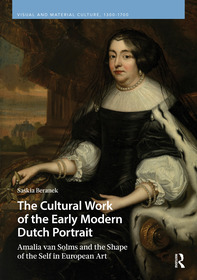
The Cultural Work of the Early Modern Dutch Portrait
Amalia van Solms and the Shape of the Self in European Art
Series: Visual and Material Culture, 1300-1700;
-
GET 10% OFF
- Publisher's listprice GBP 171.99
-
77 653 Ft (73 955 Ft + 5% VAT)
The price is estimated because at the time of ordering we do not know what conversion rates will apply to HUF / product currency when the book arrives. In case HUF is weaker, the price increases slightly, in case HUF is stronger, the price goes lower slightly.
- Discount 10% (cc. 7 766 Ft off)
- Discounted price 69 887 Ft (66 560 Ft + 5% VAT)
69 887 Ft

Availability
printed on demand
Why don't you give exact delivery time?
Delivery time is estimated on our previous experiences. We give estimations only, because we order from outside Hungary, and the delivery time mainly depends on how quickly the publisher supplies the book. Faster or slower deliveries both happen, but we do our best to supply as quickly as possible.
Product details:
- Edition number 1
- Publisher Taylor & Francis
- Date of Publication 22 April 2026
- ISBN 9789048562572
- Binding Hardback
- No. of pages214 pages
- Size 246x174 mm
- Weight 580 g
- Language English
- Illustrations 168 Illustrations, black & white 681
Categories
Short description:
The Cultural Work of the Early Modern Portrait examines how portraits of Amalia van Solms, Princess of Orange (1602-1675), functioned as active cultural agents that connected people across time and space, participating in domestic, national, and international politics throughout the 17th century.
MoreLong description:
The Cultural Work of the Early Modern Dutch Portrait examines how portraits of Amalia van Solms, Princess of Orange (1602–1675), functioned as active cultural agents that connected people across time and space, participating in domestic, national, and international politics throughout the seventeenth century.
This interdisciplinary study reveals how portraits served as powerful tools beyond mere facial records, actively negotiating relationships, building bridges, engendering communities, soothing egos, evoking memories, and constructing fame. Through engaging with gender studies, collecting and display history, Dutch art history, architectural history, and reception theory, the book challenges assumptions about what portraits accomplished, for whom, and in what spaces. By focusing on Amalia van Solms as a case study, readers gain insights into how portraits functioned as links in larger social chains and discover the sophisticated cultural work these images performed. The study promotes a collaborative, interdisciplinary approach that clarifies early modern women’s contributions to seventeenth-century art, architecture, and politics while revealing the remarkable capacity of portraits to shape social and political landscapes.
This book will appeal to scholars and students in art history, Dutch Golden Age studies, gender studies, and early modern European history. It serves as an essential resource for researchers interested in portraiture, material culture, women’s history, and interdisciplinary approaches to visual culture. The work will also engage museum professionals, curators, and anyone fascinated by the intersection of art, politics, and social networks in the early modern period.
MoreTable of Contents:
0. Introduction: The possibilities of the portrait in the early modern Dutch Republic 1. More than just a pretty face: The Agency of Portraits and their Sites of Display in Early Modern Europe 2. Communicating Power: Portraits as Polemic 3. Huis ten Bosch: Place as Portrait 4. Connecting the Court: Portrait Dissemination, Social Networks, and Cultural Capital 5. Chapter 5: Mapping Impact: Printed Portraits and Public Circulation of Portraits of Amalia van Solms 6. Conclusion
More
