

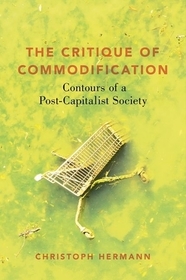
The Critique of Commodification
Contours of a Post-Capitalist Society
- Publisher's listprice GBP 88.00
-
39 732 Ft (37 840 Ft + 5% VAT)
The price is estimated because at the time of ordering we do not know what conversion rates will apply to HUF / product currency when the book arrives. In case HUF is weaker, the price increases slightly, in case HUF is stronger, the price goes lower slightly.
- Discount 10% (cc. 3 973 Ft off)
- Discounted price 35 759 Ft (34 056 Ft + 5% VAT)
Subcribe now and take benefit of a favourable price.
Subscribe
39 732 Ft

Availability
printed on demand
Why don't you give exact delivery time?
Delivery time is estimated on our previous experiences. We give estimations only, because we order from outside Hungary, and the delivery time mainly depends on how quickly the publisher supplies the book. Faster or slower deliveries both happen, but we do our best to supply as quickly as possible.
Product details:
- Publisher OUP USA
- Date of Publication 29 September 2021
- ISBN 9780197576755
- Binding Hardback
- No. of pages236 pages
- Size 162x239x17 mm
- Weight 472 g
- Language English 141
Categories
Short description:
In The Critique of Commodification, Christoph Hermann argues that commodification entails production for profit rather than provision for need. The focus on profits, Hermann shows, means that social needs are met in a way that excludes those who cannot pay and ensures high profits. In going through the damaging effects of commodification, Hermann also discusses alternatives based on the satisfaction of needs rather than maximization of profits.
MoreLong description:
In recent years activists around the globe have challenged the commodification of water, education, health care, and other essential goods, while academics have warned from unintended effects when everything can be bought and sold. But what is commodification? And what is the problem with commodification? In The Critique of Commodification, Christoph Hermann argues that commodification entails production for profit rather than social needs, and that production for profit has a number of harmful effects, including the exclusion of those who cannot pay, the marginalization of those whose collective purchasing power is not large enough, and the focus on highly profitable forms of production over more socially beneficial and ecologically sustainable alternatives. Drawing upon and extending the work of Marx, Polyani, and Luxemburg, Hermann goes beyond the standard moral critiques of markets and adopts a materialist approach to emphasize the dispossession of public resources and to highlight how goods and services are altered when sold on markets for profit. Tracing the intellectual history of the term commodification, this book not only criticizes commodification, but also proposes a new model for production that focuses on needs rather than profits.
... an important and thought-provoking contribution, one that deserves to be widely read, and it certainly provides the basis for further work in an area that is of the utmost importance.
Table of Contents:
Introduction
Chapter 1: The Critique of Commodification
Chapter 2: A Theory of Commodification
Chapter 3: Politics of Commodification
Chapter 4: Consequences of Commodification
Chapter 5: Limits of Commodification
Chapter 6: Rediscovering Use Value
Chapter 7: Alternatives to Commodification: Use Value Society
Notes
Index

