

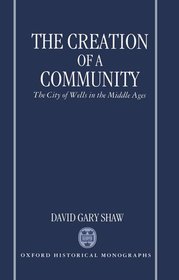
The Creation of a Community
The City of Wells in the Middle Ages
Series: Oxford Historical Monographs;
- Publisher's listprice GBP 51.00
-
23 026 Ft (21 930 Ft + 5% VAT)
The price is estimated because at the time of ordering we do not know what conversion rates will apply to HUF / product currency when the book arrives. In case HUF is weaker, the price increases slightly, in case HUF is stronger, the price goes lower slightly.
- Discount 10% (cc. 2 302 Ft off)
- Discounted price 20 724 Ft (19 737 Ft + 5% VAT)
Subcribe now and take benefit of a favourable price.
Subscribe
23 026 Ft

Availability
printed on demand
Why don't you give exact delivery time?
Delivery time is estimated on our previous experiences. We give estimations only, because we order from outside Hungary, and the delivery time mainly depends on how quickly the publisher supplies the book. Faster or slower deliveries both happen, but we do our best to supply as quickly as possible.
Product details:
- Publisher Clarendon Press
- Date of Publication 8 July 1993
- ISBN 9780198204015
- Binding Hardback
- No. of pages352 pages
- Size 223x144x26 mm
- Weight 579 g
- Language English
- Illustrations figures, tables 0
Categories
Long description:
This is the first scholarly history of the city of Wells in the Middle Ages. David Gary Shaw makes full use of the rich archives of Wells to trace its growth from a rural manor into the prosperous borough it became by the late twelfth century. Dr Shaw examines the variety of trades which flourished in Wells - including tanning, glove-making, and cloth-manufacture - and analyses the composition of the burgess community. He also explores the importance of the family, the extent of social mobility, the position of women, and the roles of conviviality on the one hand and religion on the other in shaping communal activity and communal spirit. Dr Wells makes full use of the rich archives of Wells to present in vivid and telling detail the anatomy of a medieval borough.
'Here is a valuable addition to the small corpus of modern monographs devoted to individual English towns in the medieval period. Shaw writes shrewdly about 'community', conscious of the voguish and treacherous nature of the concept. Shaw's book, while acknowledging the gap between pious ideal and reality, goes far to demonstrate the practical and ideological impact on one medieval urban society of that communitarian discourse.'
Gervase Rosser, The Ricardian, X, No. 126, Sept 1994

