

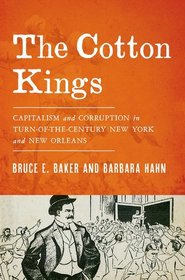
The Cotton Kings
Capitalism and Corruption in Turn-of-the-Century New York and New Orleans
- Publisher's listprice GBP 33.49
-
15 120 Ft (14 400 Ft + 5% VAT)
The price is estimated because at the time of ordering we do not know what conversion rates will apply to HUF / product currency when the book arrives. In case HUF is weaker, the price increases slightly, in case HUF is stronger, the price goes lower slightly.
- Discount 10% (cc. 1 512 Ft off)
- Discounted price 13 608 Ft (12 960 Ft + 5% VAT)
Subcribe now and take benefit of a favourable price.
Subscribe
15 120 Ft

Availability
printed on demand
Why don't you give exact delivery time?
Delivery time is estimated on our previous experiences. We give estimations only, because we order from outside Hungary, and the delivery time mainly depends on how quickly the publisher supplies the book. Faster or slower deliveries both happen, but we do our best to supply as quickly as possible.
Product details:
- Publisher OUP USA
- Date of Publication 7 January 2016
- ISBN 9780190211653
- Binding Hardback
- No. of pages232 pages
- Size 236x155x22 mm
- Weight 522 g
- Language English
- Illustrations 20 hts 0
Categories
Short description:
The Cotton Kings is a colorful account of the men who fought to control the price of cotton on unregulated exchanges in New York and New Orleans. Dishonest brokers used bad information to raise and lower prices, make or break fortunes, regardless of supply and demand.
MoreLong description:
The Cotton Kings relates a rip-roaring drama of competition in the marketplace and reveals the damage markets can cause when they do not work properly. It also explains how they can be fixed through careful regulation. At the turn of the twentieth century, cotton was still the major agricultural product of the American South and an important commodity for world industry. Key to marketing cotton were futures contracts, traded at exchanges in New York and New Orleans. Futures contracts had the potential to hedge risk and reduce price volatility, but only if the markets in which they were traded worked properly. Increasing corruption on the powerful New York Cotton Exchange pushed prices steadily downwards in the 1890s, impoverishing millions of cotton farmers. The U.S. Department of Agriculture tried to solve the problem with better crop predictions and market information, shared equally and simultaneously with all participants, but these efforts failed.
To fight the cotton market's corruption, cotton brokers in New Orleans, led by William P. Brown and Frank Hayne, began quietly to assemble resources. They triumphed in the summer of 1903, when they cornered the world market in cotton and raised its price to reflect the reality of increasing demand and struggling supply. The brokers' success pushed up the price of cotton for the next ten years. However, the structural problems of self-regulation by market participants still threatened the cotton trade. More corruption at the New York Cotton Exchange appeared, until eventually political pressure inspired the Cotton Futures Act of 1914, the federal government's first successful regulation of a financial derivative.
Table of Contents:
Introduction
Ch 1 New Orleans and the Future of the Cotton Trade
Ch 2 The Value of Information
Ch 3 Building a Bear Trap
Ch 4 Cornering Cotton
Ch 5 Of Weevils and Wool Hats
Ch 6 Of Scandals, Sunshine, and Manipulation
Ch 7 Revenge of the Bears
Ch 8 The Perpetual Squeeze
Ch 9 The Cotton Futures Act of 1914
Conclusion
Notes
Bibliography
Index

