

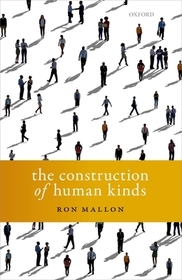
The Construction of Human Kinds
- Publisher's listprice GBP 30.00
-
13 545 Ft (12 900 Ft + 5% VAT)
The price is estimated because at the time of ordering we do not know what conversion rates will apply to HUF / product currency when the book arrives. In case HUF is weaker, the price increases slightly, in case HUF is stronger, the price goes lower slightly.
- Discount 10% (cc. 1 355 Ft off)
- Discounted price 12 191 Ft (11 610 Ft + 5% VAT)
Subcribe now and take benefit of a favourable price.
Subscribe
13 545 Ft

Availability
Uncertain availability. Please turn to our customer service.
Why don't you give exact delivery time?
Delivery time is estimated on our previous experiences. We give estimations only, because we order from outside Hungary, and the delivery time mainly depends on how quickly the publisher supplies the book. Faster or slower deliveries both happen, but we do our best to supply as quickly as possible.
Product details:
- Publisher OUP Oxford
- Date of Publication 1 August 2016
- ISBN 9780198755678
- Binding Hardback
- No. of pages272 pages
- Size 234x153 mm
- Language English 0
Categories
Short description:
Ron Mallon explores how thinking and talking about kinds of person can bring those kinds into being. He considers what normative implications this social constructionism has for our understanding of our practices of representing human kinds, like race, gender, and sexual orientation, and for our own agency.
MoreLong description:
Ron Mallon explores how thinking and talking about kinds of person can bring those kinds into being. Social constructionist explanations of human kinds like race, gender, and homosexuality are commonplace in the social sciences and humanities, but what do they mean and what are their implications?
This book synthesizes recent work in evolutionary, cognitive, and social psychology as well as social theory and the philosophy of science, in order to offer a naturalistic account of the social construction of human kinds. Mallon begins by qualifying social constructionist accounts of representations of human kinds by appealing to evidence suggesting canalized dispositions towards certain ways of representing human groups, using race as a case study. He then turns to interpret
constructionist accounts of categories as attempts to explain causally powerful human kinds by appealling to our practices of representing them, and he articulates a view in which widespread representations produce entrenched social roles that could vindicate such attempts.
Mallon goes on to explore constructionist concerns with the social consequences of our representations, focusing especially on the way human kind representations can alter our behaviour and undermine our self understandings and our agency. Mallon understands socially constructed kinds as the real, sometimes stable products of our cognitive and representational practices, and he suggests that reference to such kinds can figure in our everyday and scientific practices of representing the social
world. The result is a realistic, naturalistic account of how human representations might contribute to making up the parts of the social world that they represent.
Table of Contents:
Introduction
Part I: Constructing Human Kinds
Constructing and Constraining Representations: Was Race Thinking Invented in the Modern West?
Constructing Categories: Concepts, Actions and Social Roles
Social Roles that Matter
Natural Permission and the Naturalistic Fallacy
Performed Categories, Self-Explanation, and Agency
Part II: Realizing Social Construction
Social Construction and Reality
Achieving Stability
Achieving Reference
Conclusion: Alternatives and Implications
Acknowledgements
Bibliography

