

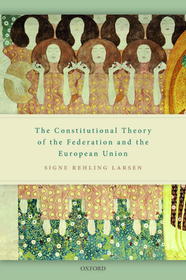
The Constitutional Theory of the Federation and the European Union
- Publisher's listprice GBP 107.50
-
48 536 Ft (46 225 Ft + 5% VAT)
The price is estimated because at the time of ordering we do not know what conversion rates will apply to HUF / product currency when the book arrives. In case HUF is weaker, the price increases slightly, in case HUF is stronger, the price goes lower slightly.
- Discount 10% (cc. 4 854 Ft off)
- Discounted price 43 683 Ft (41 603 Ft + 5% VAT)
Subcribe now and take benefit of a favourable price.
Subscribe
48 536 Ft

Availability
Estimated delivery time: In stock at the publisher, but not at Prospero's office. Delivery time approx. 3-5 weeks.
Not in stock at Prospero.
Why don't you give exact delivery time?
Delivery time is estimated on our previous experiences. We give estimations only, because we order from outside Hungary, and the delivery time mainly depends on how quickly the publisher supplies the book. Faster or slower deliveries both happen, but we do our best to supply as quickly as possible.
Product details:
- Publisher OUP Oxford
- Date of Publication 4 February 2021
- ISBN 9780198859260
- Binding Hardback
- No. of pages240 pages
- Size 242x165x17 mm
- Weight 564 g
- Language English 76
Categories
Short description:
This book departs from the 'statist' imagination by suggesting the EU is a federal union of states, or a federation. Dedicated to the constitutional theory of federalism, this book gives the strengths and weaknesses of a federation as a political form, its histories, and current perils for the EU.
MoreLong description:
From the start of the European integration process, one question has puzzled scholars: what type of political association is the European Union? In absence of an agreed upon response, most scholars have suggested that the European Union is 'sui generis'. This book challenges the sui generis thesis by demonstrating that the EU is not a unique form of association, but rather a federal union of states, or what this book calls a federation. This is a discrete form of political association on par with, though differentiated from, political modernity's two other main forms, namely the state and the empire.
The federation cannot be understood on the basis of the general theory of the state or its concept of sovereignty. The 'statist' imaginary still dominates both the debates on federalism and the EU, meaning that all federal policies are either seen as 'confederal' associations of sovereign states or sovereign federal states. This book challenges this binary by demonstrating that the federation is not a 'super state' but a discrete political form with its own constitutional theory. It is characterized by a double political existence, a lack of internal hierarchy, and the internal absence, contestation, or repression of sovereignty. This book details the key aspects of federal constitutional theory and how this theory accounts for the EU's constitutional form as well as the crises it has faced in recent years.
This book is broken into five chapters that cover the introduction to federalism, origins of the EU, state transformation and teleology, unity in diversity, and emergency rule without a sovereign. This book draws on a variety of literatures and historical material to help the reader develop a critical understanding of 'constitutional myths' and the theory of federalism.
This book is a revelation. Anyone wanting an objective understanding of the EU as a model of government must read it ...
Table of Contents:
Introduction
Constitutional Nature
Origins and Telos
State Transformation and Teleology
United in Diversity
Emergency Rule Without a Sovereign
Conclusion

