

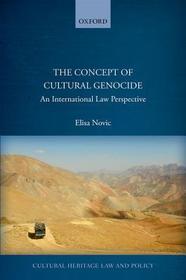
The Concept of Cultural Genocide
An International Law Perspective
Series: Cultural Heritage Law and Policy;
- Publisher's listprice GBP 127.50
-
57 566 Ft (54 825 Ft + 5% VAT)
The price is estimated because at the time of ordering we do not know what conversion rates will apply to HUF / product currency when the book arrives. In case HUF is weaker, the price increases slightly, in case HUF is stronger, the price goes lower slightly.
- Discount 10% (cc. 5 756 Ft off)
- Discounted price 51 810 Ft (49 343 Ft + 5% VAT)
Subcribe now and take benefit of a favourable price.
Subscribe
57 566 Ft

Availability
Estimated delivery time: In stock at the publisher, but not at Prospero's office. Delivery time approx. 3-5 weeks.
Not in stock at Prospero.
Why don't you give exact delivery time?
Delivery time is estimated on our previous experiences. We give estimations only, because we order from outside Hungary, and the delivery time mainly depends on how quickly the publisher supplies the book. Faster or slower deliveries both happen, but we do our best to supply as quickly as possible.
Product details:
- Publisher OUP Oxford
- Date of Publication 20 October 2016
- ISBN 9780198787167
- Binding Hardback
- No. of pages288 pages
- Size 239x167x23 mm
- Weight 588 g
- Language English 40
Categories
Short description:
This book details how international law has approached the core idea underlying the concept of cultural genocide and how this framework can be strengthened and fostered. The volume traces developments from the early conceptualisation of cultural genocide to the contemporary question of its reparation.
MoreLong description:
Cultural genocide is the systematic destruction of traditions, values, language, and other elements that make one group of people distinct from another.Cultural genocide remains a recurrent topic, appearing not only in the form of wide-ranging claims about the commission of cultural genocide in diverse contexts but also in the legal sphere, as exemplified by the discussions before the International Criminal Tribunal for the Former Yugoslavia and also the drafting of the UN Declaration on the Rights of Indigenous Peoples. These discussions have, however, displayed the lack of a uniform understanding of the concept of cultural genocide and thus of the role that international law is expected to fulfil in this regard.
The Concept of Cultural Genocide: An International Law Perspective details how international law has approached the core idea underlying the concept of cultural genocide and how this framework can be strengthened and fostered. It traces developments from the early conceptualisation of cultural genocide to the contemporary question of its reparation. Through this journey, the book discusses the evolution of various branches of international law in relation to both cultural protection and cultural destruction in light of a number of legal cases in which either the concept of cultural genocide or the idea of cultural destruction has been discussed. Such cases include the destruction of cultural and religious heritage in Bosnia and Herzegovina, the forced removals of Aboriginal children in Australia and Canada, and the case law of the Inter-American Court of Human Rights in relation to Indigenous and tribal groups' cultural destruction.
Table of Contents:
Introduction
The Concept of Cultural Genocide: a Historical-Legal Perspective
The Cultural Dimension of the Crime of Genocide
International Law and the Protection of Cultures
Beyond Words: From 'Cultural Genocide' to 'Cultural Persecution'
State Responsibility for Cultural Crimes
Reparation for Intended Cultural Harm
Conclusions

