

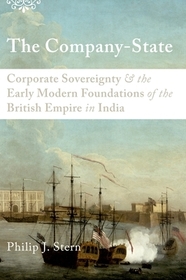
The Company-State
Corporate Sovereignty and the Early Modern Foundations of the British Empire in India
- Publisher's listprice GBP 45.99
-
20 764 Ft (19 775 Ft + 5% VAT)
The price is estimated because at the time of ordering we do not know what conversion rates will apply to HUF / product currency when the book arrives. In case HUF is weaker, the price increases slightly, in case HUF is stronger, the price goes lower slightly.
- Discount 10% (cc. 2 077 Ft off)
- Discounted price 18 687 Ft (17 798 Ft + 5% VAT)
Subcribe now and take benefit of a favourable price.
Subscribe
20 764 Ft

Availability
printed on demand
Why don't you give exact delivery time?
Delivery time is estimated on our previous experiences. We give estimations only, because we order from outside Hungary, and the delivery time mainly depends on how quickly the publisher supplies the book. Faster or slower deliveries both happen, but we do our best to supply as quickly as possible.
Product details:
- Publisher OUP USA
- Date of Publication 29 November 2012
- ISBN 9780199930364
- Binding Paperback
- No. of pages316 pages
- Size 231x155x17 mm
- Weight 476 g
- Language English
- Illustrations 13 illus. 60
Categories
Short description:
The Company-State offers a political and intellectual history of the English East India Company in the century before its acquisition of territorial power. It argues the Company was no mere merchant, but a form of early modern, colonial state and sovereign that laid the foundations for the British Empire in India.
MoreLong description:
Almost since the event itself in 1757, the English East India Company's victory over the forces of the nawab of Bengal and the territorial acquisitions that followed has been perceived as the moment when the British Empire in India was born. Examining the Company's political and intellectual history in the century prior to this supposed transformation, The Company-State rethinks this narrative and the nature of the early East India Company itself.
In this book, Philip J. Stern reveals the history of a corporation concerned not simply with the bottom line but also with the science of colonial governance. Stern demonstrates how Company leadership wrestled with typical early modern problems of political authority, such as the mutual obligations of subjects and rulers; the relationships among law, economy, and sound civil and colonial society; the constitution of civic institutions ranging from tax collection and religious practice to diplomacy and warmaking; and the nature of jurisdiction and sovereignty over people, territory, and the sea. Their ideas emerged from abstract ideological, historical, and philosophical principles and from the real-world entanglements of East India Company employees and governors with a host of allies, rivals, and polyglot populations in their overseas plantations. As the Company shaped this colonial polity, it also confronted shifting definitions of state and sovereignty across Eurasia that ultimately laid the groundwork for the Company's incorporation into the British empire and state through the eighteenth century.
Challenging traditional distinctions between the commercial and imperial eras in British India, as well as a colonial Atlantic world and a "trading world" of Asia, The Company-State offers a unique perspective on the fragmented nature of state, sovereignty, and empire in the early modern world.
With great skill, Stern has extracted from the archives a cogent and highly engaging narrative of events that even participants found highly tremendously confusing. He deftly conveys the world of the East India company, marshaling striking visual materials and wonderfully evocative quotations from a wide array of Company documents.
Table of Contents:
Introduction: "A State in the Disguise of a Merchant"
Part I: Foundations
Chapter 1 "Planning & Peopling Your Colony": Building a Company-State
Chapter 2 "A Sort of Republic for the Management of Trade": The Jurisdiction of a Company-State
Chapter 3 "A Politie of Civill and Military Power": Diplomacy, War, and Expansion
Chapter 4 "Politicall Science and Martiall Prudence": Political Thought and Political Economy
Chapter 5 "The Most Sure and Profitable Sort of Merchandice": Protestantism and Piety
Part II: Transformations
Chapter 6 "Great Warrs Leave Behind them Long Tales": Crisis and Response in Asia after 1688
Chapter 7 Auspicio Regis et Senatus Angliae": Crisis and Response in Britain after 1688
Chapter 8 "The Day of Small Things": Civic Governance in the New Century
Chapter 9 "A Sword in One Hand & Money in the Other": Old Patterns, New Rivals
Conclusion "A Great and Famous Superstructure"
Abbreviations
Glossary
Notes
Index

