

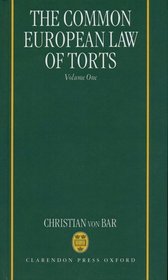
The Common European Law of Torts: Volume One
- Publisher's listprice GBP 367.50
-
165 926 Ft (158 025 Ft + 5% VAT)
The price is estimated because at the time of ordering we do not know what conversion rates will apply to HUF / product currency when the book arrives. In case HUF is weaker, the price increases slightly, in case HUF is stronger, the price goes lower slightly.
- Discount 10% (cc. 16 593 Ft off)
- Discounted price 149 334 Ft (142 223 Ft + 5% VAT)
Subcribe now and take benefit of a favourable price.
Subscribe
165 926 Ft

Availability
printed on demand
Why don't you give exact delivery time?
Delivery time is estimated on our previous experiences. We give estimations only, because we order from outside Hungary, and the delivery time mainly depends on how quickly the publisher supplies the book. Faster or slower deliveries both happen, but we do our best to supply as quickly as possible.
Product details:
- Edition number and title :Volume One
- Publisher Clarendon Press
- Date of Publication 17 December 1998
- ISBN 9780198260561
- Binding Hardback
- No. of pages808 pages
- Size 242x163x45 mm
- Weight 1225 g
- Language English 0
Categories
Short description:
This awe-inspiring book is the first of a two volume treatise on the law of non-contractual obligations. The result of a unique attempt to discover the common elements of the law of torts of all the member states of the European Union, it is founded on the belief that the approximation of European laws should not be left to the directives and regulations of Brussels alone. To this end, von Bar has undertaken a thorough, detailed and extensive analysis of the relevant court rulings and academic writings of all the jurisdictions of the European Union to distill a common European law of torts. The insights gained from the comparative analysis also offer a guidance to greater harmonisation in the future. It is destined to become a landmark in the area of comparative law in general, and comparative torts in particular.
MoreLong description:
This awe-inspiring book is the first of a two volume treatise on the law of non-contractual obligations. The result of a unique attempt to discover the common elements of the law of torts of all the member states of the European Union, it is founded on the belief that the approximation of European laws should not be left to the directives and regulations of Brussels alone. The first task of such a project is to determine to what extent a jus commune europaeum already exists. To this end, von Bar has undertaken a thorough, detailed and extensive analysis of the relevant court rulings and academic writings of all the jurisdictions of the European Union to distill a European common law of torts. The insights gained from the comparative analysis also offer a guidance to greater harmonisation in the future.
The material covered in volume one includes: the areas of application of tort law and its boundaries with contract, property, criminal and constitutional law; the elements of liability under the general clauses of the European civil codes and the more specific torts of the common law. Further topics include: strict liability, liability for other persons, animals and premises; multiple tortfeasors; and an account of European Union and Council of Europe attempts to harmonise the less coherent areas of tort law.
Von Bar's book is destined to become a landmark in the area of comparative law in general, and comparative torts in particular.
From the author's preface
The attempt undertaken here to draw up a system of a common European law of torts is an orthodox treatise on the non-contractual law of obligations. This book displays distinctive features only in so far as its material stems from all the laws of tort within the European Union. It seemed possible to understand and portray each tort law as merely a national manifestation of a single discipline. For, although different legal practices which have each grown naturally in their own environment do occasionally lead to different results, they can be dealt with in the same way as a single legal system in which a lawyer has to find his way through a variety of opinions. The person who looks, not only at his own, but also surrounding laws, broadens the range of possible debate. In writing about different laws he undertakes work fundamentally no different from that on his own legal system, so long as the systems are equal in their basic values, in the quality of their legal method, and have continuously learned from each other. This is the case in the countries of the European Union, and it is therefore possible to condense their different national laws to a common European law of torts (or delict). To try to understand its structures does not mean leaving distinctive features of individual nations out of consideration. Without an understanding of their effectiveness and their elegance, the treasure of judicial knowledge, which distinguishes European private law, will not be appreciated. However, to think in a European fashion firstly means stressing the common characteristics, secondly, learning to understand national laws as reactions to developments in neighbouring countries, and thirdly, tackling historical coincidences and rough edges
European politics is not our primary concern, and the question whether reflections on common European private law can flow into a general law, that is to say into an extensive unification of law in the fashion of a Civil Code, is altogether a cura posterior. The challenge is to identify how the sixteen systems actually function, not how they would function were they united in one system. we are portraying here, not a single national law in comparison with other laws, rather we have chosen from the start a European standpoint; European meaning the states of the European Union
... goes well beyond the scope of a textbook, being at the very least a major comparative analysis and work of research and scholarship.
Table of Contents:
Foreword by Lord Goff of Chieveley
Part 1. Foundations
Part 2. Continental Europe's Codified Law of Delict
Part 3. The Scandinavian Liability Laws and the Common Law of Torts
Part 4. Unification and Approximation of the Law of Delict within the European Union
Part 5. The Law of Delict in the Context of Private Law
Part 6. The Law of Delict, Constitutional and Criminal Law

