

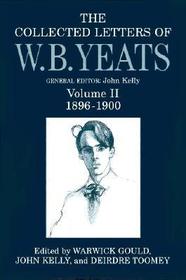
The Collected Letters of W. B. Yeats: Volume II: 1896-1900
Series: Yeats Collected Letters Series;
- Publisher's listprice GBP 250.00
-
112 875 Ft (107 500 Ft + 5% VAT)
The price is estimated because at the time of ordering we do not know what conversion rates will apply to HUF / product currency when the book arrives. In case HUF is weaker, the price increases slightly, in case HUF is stronger, the price goes lower slightly.
- Discount 10% (cc. 11 288 Ft off)
- Discounted price 101 588 Ft (96 750 Ft + 5% VAT)
Subcribe now and take benefit of a favourable price.
Subscribe
112 875 Ft

Availability
printed on demand
Why don't you give exact delivery time?
Delivery time is estimated on our previous experiences. We give estimations only, because we order from outside Hungary, and the delivery time mainly depends on how quickly the publisher supplies the book. Faster or slower deliveries both happen, but we do our best to supply as quickly as possible.
Product details:
- Edition number and title :Volume II: 1896-1900
- Publisher OUP Oxford
- Date of Publication 4 September 1997
- ISBN 9780198126829
- Binding Hardback
- No. of pages872 pages
- Size 242x164x49 mm
- Weight 1472 g
- Language English
- Illustrations 8 pp plates 0
Categories
Short description:
Described by Seamus Heaney as `one of the great publishing events of the decade', The Collected Letters of W. B. Yeats is redefining the territory of modern literary history.
Covering a formative period in Yeats's political career, and the beginning of his theatrical involvement, Volume II (1896-1900) is indispensable to anyone interested in modern poetry, Irish drama, and cultural history. Letter by letter Yeat's private concerns, artistic quarrels and exhausting political life are revealed. Rich and readable notes provide a narrative of these years, explaining allusions, and setting the correspondence in its cultural and political contexts, as well as relating it to the emergence of Yeats's canon.
Long description:
The letters in this volume, the majority never before published, vividly document the period in which Yeats, having left the family house in Bedford Park, began a new life in Bloomsbury; as he later recalled, `a new scene was set, new actors appeared'. With his association with the Savoy magazine and its circle of decadents, he achieved the financial emancipation that enabled him to begin his first affair with Olivia Shakespear. 1896 also saw the beginning of the most important and creative friendship of his life, that with Lady Gregory; other influential friendships, such as those with Synge and W. T. Horton, were forged. In 1898, Yeats's friendship with George Moore expanded, only to contract with the disastrous collaboration on Diarmuid and Grania.
It was a period of considerable unhappiness for Yeats. His love for Maud Gonne was hopeless; in December 1898, she was to tell him of her long-standing affair with Lucian Millevoye (by whom she had two children). The crisis produced a run of confused and incoherent letters to Lady Gregory.
The letters also document Yeats's greatest early period of political activity. He organized the centenary celebrations of the 1798 uprising, while combating double agents within the Irish Revolutionary Brotherhood. In 1897, he began planning a National Theatre and letters chart a massive expansion of theatrical activity.
Letter by letter, we see how private concerns, artistic quarrels and exhausting political life forced him to develop a public persona. Rich and readable notes provide a narrative of these years, explaining allusions and setting the correspondence in its cultural and political contexts, as well as relating it to the emergence of Yeats's canon. The Collected Letters of W. B. Yeats is redefining the territory of modern literary history and this volume, with its valuable biographical and thematic appendices, is indispensable to anyone interested in the development of modern poetry, Irish drama and cultural history.
From reviews of Volume I:
`magnificent ... The detail is immense and spot on, so that the footnotes read as a continuous, densely peopled, unfailingly informative documentary on the life and times of the sedulous correspondent ... the start of an edition that is going to be one of the great publishing events of the decade.' Seamus Heaney, Observer

