

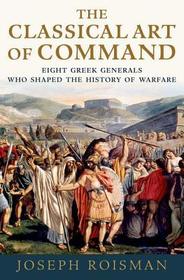
The Classical Art of Command
Eight Greek Generals Who Shaped the History of Warfare
- Publisher's listprice GBP 43.49
-
20 777 Ft (19 787 Ft + 5% VAT)
The price is estimated because at the time of ordering we do not know what conversion rates will apply to HUF / product currency when the book arrives. In case HUF is weaker, the price increases slightly, in case HUF is stronger, the price goes lower slightly.
- Discount 10% (cc. 2 078 Ft off)
- Discounted price 18 699 Ft (17 808 Ft + 5% VAT)
Subcribe now and take benefit of a favourable price.
Subscribe
20 777 Ft

Availability
printed on demand
Why don't you give exact delivery time?
Delivery time is estimated on our previous experiences. We give estimations only, because we order from outside Hungary, and the delivery time mainly depends on how quickly the publisher supplies the book. Faster or slower deliveries both happen, but we do our best to supply as quickly as possible.
Product details:
- Publisher OUP USA
- Date of Publication 30 March 2017
- ISBN 9780199985821
- Binding Hardback
- No. of pages416 pages
- Size 218x135x33 mm
- Weight 499 g
- Language English
- Illustrations 18 b/w line drawings; 20 b/w halftones 0
Categories
Short description:
This book examines the many facets of Greek leadership during the Classical Age through the unique perspective of eight generals regarded as outstanding shapers of Greek military history. The work also draws attention to the important role that the general's personality played in his command.
MoreLong description:
This book uniquely looks at the many facets of Greek generalship through the individual careers of some of the best-known Greek commanders. They include the Spartan king Leonidas, who embodied his countrymen's heroic ethos in the battle of Thermopylae against the Persian invader; the Athenian leader Themistocles, credited as the architect of Athens' naval power and of the Greek victory over the Persians; the famous democratic leader, Pericles, who prepared Athens and directed its conflict with Sparta, known as the Peloponnesian War; the Athenian general Demosthenes, who deviated from contemporary conventions of warfare with his innovative approach; the Spartan general Lysander, who won the Peloponnesian War for Sparta; Dionysius I of Syracuse, Sicily, arguably the most innovative and best skilled of the eight generals discussed in this book; and Epaminondas and Pelopidas who together transformed their city, Thebes, into an hegemonic power. The book describes the nature of these leaders' command and the mark they left on Greek history and warfare. It draws attention to the important role that personality played in their leadership, which justifies investigating Greek generalship through the individual careers of commanders. The book discusses how these generals designed and executed military campaigns and strategy, and to what degree they were responsible for the results. The book also looks at how far the Greek art of command changed during the Classical Age, and how adaptable it was to different military challenges. Other questions involve the extent to which a general was a mere leader of the charge, a battle director or a strategist, and what made both ancient and modern authorities regard the aforementioned generals outstanding shapers of Greek military history. The book will appeal to readers who are new to, but interested in, ancient warfare and generalship. Original observations and analyses, in addition to informative notes and bibliography, should make the book attractive to experts too.
This is an important book, accessible to students, scholars, and the lay reader. The writing style is clear and focused, and in each chapter Roisman blends ancient evidence with scholarly perception, reaching compelling and thought-provoking conclusions. This will become a standard work in the study of ancient warfare and military leadership.
Table of Contents:
CONTENTS
List of Maps and Illustrations
List of Abbreviations
Introduction: Greek Generals and Warfare in the Classical Age
Eight Greek Generals
Two Generals in Action
Greek Generals: Responsibilities and Personality
What Generals Did, Their Qualifications, and Their Offices
Land Warfare
The Armies of Sparta, Athens, Boeotia, Syracuse, Persia, and Carthage
Greek Battleships and Navies
CH. 1 Leonidas of Sparta: the Lion at the Gates
Leonidas' Sparta and His Military Challenges
The Threat of War Preliminaries to the battle of Thermopylae Leonidas in Thermopylae
The Aftermath
Conclusion
CH. 2 Themistocles of Athens: the Clever Counselor
Themistocles, His City and His Military Challenges
Themistocles and the Athenian Navy
Themistocles and the Persian War till the Battle of Artemision
Themistocles in Artemision
The Battle of Salamis
Themistocles after Salamis Conclusion
CH. 3 Pericles of Athens: the Magisterial Commander
Pericles, Athenian Democracy and His Military Challenges
Pericles' Generalship Prior to the War against Samos (463/2?441)
The Samian Revolt
Pericles' Strategy of the Peloponnesian War Pericles and the Peloponnesian War: The Limits of his Strategy
Conclusion
Ch. 4 Demosthenes of Athens: The Master of Surprise
Demosthenes and His Military Challenges
Defeat and Victories in Western Greece
Astonishing Success in Pylos
Sneak Attack on Megara
Coming Out Empty-Handed in Boeotia
Disaster in Sicily
Conclusion
CH. 5 Lysander of Sparta: The Lion and the Fox
Lysander and His Military Challenges
Lysander's First Admiralship and the Battle of Notium
Victory at Aegospotami
Lysander and the Spartan Empire
The Fall of a Hero
Conclusion
CH. 6 Dionysius I of Syracuse: The Evolution of a General
Dionysius' Syracuse and His Military Challenges
Dionysius' Early Career up to the Battle of Gela (405)
The Buildup of Syracuse's Power
Preparations for the Second Carthaginian War (397-392)
The Siege of Motya
Besieged in Syracuse
Campaigns in Southern Italy (ca. 396-383)
The Third and Fourth Carthaginian Wars (383-367)
Conclusion
Ch. 7 Epaminondas and Pelopidas of Thebes
Epaminondas and Pelopidas, Their Military Challenges and Their City
Revolution in Thebes
The Sacred Band and the Battle of Tegyra (375)
The Battle of Leuctra (371)
Theban Supremacy and the First Invasion of the Peloponnese
The Second Invasion of the Peloponnese
Pelopidas' Missteps in Thessaly
The Third Invasion of the Peloponnese and the Naval Bill
Pelopidas' Last Battle
Epaminondas' Last Battle
Conclusion
Ch. 8 Conclusion
The Art of Command: Planning, Management and Tactics
The Art of Command: Personality
Bibliography
A. The Main Ancient Sources
B. Modern Literature

