

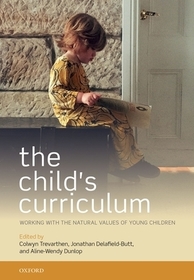
The Child's Curriculum
Working with the Natural Values of Young Children
- Publisher's listprice GBP 58.00
-
26 187 Ft (24 940 Ft + 5% VAT)
The price is estimated because at the time of ordering we do not know what conversion rates will apply to HUF / product currency when the book arrives. In case HUF is weaker, the price increases slightly, in case HUF is stronger, the price goes lower slightly.
- Discount 10% (cc. 2 619 Ft off)
- Discounted price 23 568 Ft (22 446 Ft + 5% VAT)
Subcribe now and take benefit of a favourable price.
Subscribe
26 187 Ft

Availability
printed on demand
Why don't you give exact delivery time?
Delivery time is estimated on our previous experiences. We give estimations only, because we order from outside Hungary, and the delivery time mainly depends on how quickly the publisher supplies the book. Faster or slower deliveries both happen, but we do our best to supply as quickly as possible.
Product details:
- Publisher OUP Oxford
- Date of Publication 14 September 2018
- ISBN 9780198747109
- Binding Paperback
- No. of pages348 pages
- Size 246x172x16 mm
- Weight 656 g
- Language English 0
Categories
Short description:
All children are born with emotional talent. If left untended, those talents can wane during the first five years of life. The book focusses on children's readiness for learning. It addresses the natural joy explicit in children's early conversations and engagement with music and their development through play with both adults and other children.
MoreLong description:
All children are born with emotional talent. But if left untended, those talents can wane during the first five years of life. Children are sensitive and social beings from birth, exhibiting an innate enthusiasm for communication that must be satisfied for healthy development. If their feelings, agency, and motivations are met with affection, if they are respected and nurtured, then children will respond creatively and that inherent desire for companionship will flourish.
However, with the recent changes in political and educational systems, early years education has seen a decline in focus on the emotional wellbeing of children and the development of their creativity. Those systems need to adapt if educators are to bring out the best in our future generations. By nurturing creativity and emotional wellbeing in the first five years of life, long term social benefits can be wrought.
The book focusses on children's readiness for learning. It addresses the natural joy explicit in children's early conversations and engagement with music and their development through play with both adults and other children. This kind of education allows children to develop their bodies and skills, accept and understand their feelings, build relationships, and progress both their imagination and their problem solving skills. In this way, play with others drives development.
With contributors from the fields of psychological, educational, and political spheres, this book will be of interest to anyone concerned for the future of our children.
Table of Contents:
Defining the Child's Curriculum, and its role in the life of the community
What young children give to our learning
The Importance of Play
The emotional and embodied nature of human understanding: Sharing narratives of meaning
Access to Enriching Environments in Early Childhood: Paradise lost?
The Evolved Developmental Niche and Children's Developing Morality
Children's Aesthetic Agency: The pleasures and power of imagination
The Spiritual Strengths of Young Children
Early human relations set the foundation for adult health and working life
Gender balance in the childcare workforce: Why having more men in childcare is important
The Courage of Utopia
Child's Curriculum as a Gift: Opening up the early level curriculum in Scotland
Early childhood education and care policy: Beyond quantity and quality, for human development
Communities Raising Children Together: Collaborative Consultation with a Place-Based Initiative in Harlem
Involving Parents in Their Children's Learning
Children's 'working theories' as curriculum outcomes
The spirit of the child inspires learning in the community: how can we balance this promise with the politics and practise of education?

