

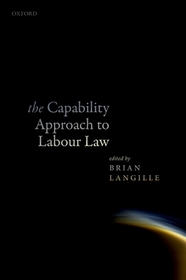
The Capability Approach to Labour Law
- Publisher's listprice GBP 110.00
-
49 665 Ft (47 300 Ft + 5% VAT)
The price is estimated because at the time of ordering we do not know what conversion rates will apply to HUF / product currency when the book arrives. In case HUF is weaker, the price increases slightly, in case HUF is stronger, the price goes lower slightly.
- Discount 10% (cc. 4 967 Ft off)
- Discounted price 44 699 Ft (42 570 Ft + 5% VAT)
Subcribe now and take benefit of a favourable price.
Subscribe
49 665 Ft

Availability
Uncertain availability. Please turn to our customer service.
Why don't you give exact delivery time?
Delivery time is estimated on our previous experiences. We give estimations only, because we order from outside Hungary, and the delivery time mainly depends on how quickly the publisher supplies the book. Faster or slower deliveries both happen, but we do our best to supply as quickly as possible.
Product details:
- Publisher OUP Oxford
- Date of Publication 4 April 2019
- ISBN 9780198836087
- Binding Hardback
- No. of pages386 pages
- Size 239x165x29 mm
- Weight 724 g
- Language English 0
Categories
Short description:
This collection investigates whether and how the capability approach can help us understand, justify, and reform labour law.
MoreLong description:
Forty years ago Amartya Sen introduced to the world a novel approach to the idea of equality: the notion of 'basic capability' as 'a morally relevant dimension' and the claim that we should focus upon equality of basic capabilities ('a person being able to do certain basic things'). These ideas, as developed by Sen and Martha C. Nussbaum, have launched an academic armada now proceeding under the flag of the 'capability approach' (CA). While that flag has ventured far and wide and engaged many areas of inquiry, this volume of essays is the first to explore how CA might shed light upon labour law.
The capabilities approach can illuminate our understanding of labour law across three dimensions. Part I looks at the nature of the basic relationship between CA and labour law-do they share common ground or disagree about what is important? Can the CA provide a normative 'foundation' for labour law? Part II goes further by examining the relationship of the CA and other well-established perspectives on labour law, including economics, history, critical theory, restorative justice, and human rights. Part III examines the possible relevance of the CA to a range of specific labour law issues, such as freedom of association, age discrimination in the workplace, trade, employment policy, and sweatshop goods.
Table of Contents:
Introduction: The Capability Approach to Labour Law-Why Are We Here?
Part I: The Capability Approach and Labour Law: Fundamental Questions
What Can Sen's Capability Approach Offer to Labour Law
The Capability Approach and Labour Law: Identifying the Areas of Fit
Labor Law and the Capabilities Approach
Is the Capability Theory an Adequate Normative Theory for Labour Law?
The Need to Become Fashionable
1. What is Labour Law? Implications of the Capabilities Approach
Part II: The Capability Approach to Labour Law from Other Disciplinary Perspectives
The Capability Approach and the Economics of Labour Law
Labor History and the Clash of Capabilities
Capabilities, Utility, or Primary Goods? On Finding a Conceptual Framework for (International) Labour Law
Work, Human Rights, and Human Capabilities
Capabilities Approaches and Labour Law through a Restorative Regulatory Lens
Part III: The Capability Approach to Labour Law and Important Labour Law Controversies
The Constitution of Capabilities: The Case of Freedom of Association
Capabilities and Age Discrimination
(Re)Imagining the Trade-Labour Linkage: The Capabilities Approach
Freedom in Work and the Capability Approach: Towards a Politics of Freedoms for Labour?
Capabilities, Contract, and Causality: The Case of Sweatshop Goods

