

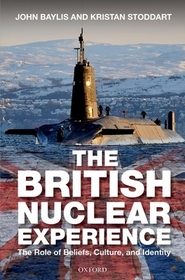
The British Nuclear Experience
The Roles of Beliefs, Culture and Identity
- Publisher's listprice GBP 110.00
-
49 665 Ft (47 300 Ft + 5% VAT)
The price is estimated because at the time of ordering we do not know what conversion rates will apply to HUF / product currency when the book arrives. In case HUF is weaker, the price increases slightly, in case HUF is stronger, the price goes lower slightly.
- Discount 10% (cc. 4 967 Ft off)
- Discounted price 44 699 Ft (42 570 Ft + 5% VAT)
Subcribe now and take benefit of a favourable price.
Subscribe
49 665 Ft

Availability
printed on demand
Why don't you give exact delivery time?
Delivery time is estimated on our previous experiences. We give estimations only, because we order from outside Hungary, and the delivery time mainly depends on how quickly the publisher supplies the book. Faster or slower deliveries both happen, but we do our best to supply as quickly as possible.
Product details:
- Publisher OUP Oxford
- Date of Publication 18 December 2014
- ISBN 9780198702023
- Binding Hardback
- No. of pages312 pages
- Size 240x163x22 mm
- Weight 634 g
- Language English 0
Categories
Short description:
Based on a detailed analysis of archives and high level interviews this book looks at the role of beliefs, culture and identity in the making of British nuclear policy from 1945 through to the present day.
MoreLong description:
Based on a detailed analysis of archives and high level interviews this book looks at the role of beliefs, culture and identity in the making of British nuclear policy from 1945 through to the present day. This book also examines Britain's nuclear experience by moving away from traditional interpretations of why states develop and maintain nuclear weapons by adopting a more contemporary approach to political theory.
Traditional mainstream explanations tend to stress the importance of factors such as the 'maximization of power', the pursuit of 'national security interests' and the role of 'structure' in a largely anarchic international system. This book does not dismiss these approaches, but argues that British experience suggests that focusing on 'beliefs', 'culture' and 'identity', provides a more useful insight and distinctive interpretation into the process of British nuclear decision making than the more traditional approaches.
Anyone wishing to understand the United Kingdom's seven-decades-old relationship with nuclear weapons...should start with this excellent new book by leading British scholars John Baylis and Kristan Stoddart. The British Nuclear Experience provides a fascinating and highly accessible narrative of the somewhat peculiar story of both the day-to-day dynamics and the broader evolution of nuclear thinking and policy in the United Kingdom.
Table of Contents:
Introduction
The Emergence of a Deterrence 'Habit of Mind'
The Chiefs of Staff, Nuclear Weapons and Global Strategy
From Atomic Weapons to Thermonuclear Weapons
Forging the 'Special' Anglo-American Nuclear Relationship
Polaris, Independence and Interdependence
The Polaris Improvement Programme and Chevaline
The Polaris Replacement Debate under Labour
The Adoption of Trident
NATO Modernization Plans, SDI and the End of the Cold War
Trident Replacement/Renewal: From 'New Labour' to the Coalition Government
Conclusion

