

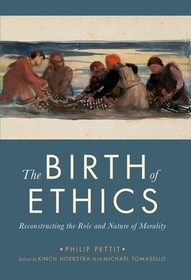
The Birth of Ethics
Reconstructing the Role and Nature of Morality
Series: The Berkeley Tanner Lectures;
- Publisher's listprice GBP 24.99
-
11 282 Ft (10 745 Ft + 5% VAT)
The price is estimated because at the time of ordering we do not know what conversion rates will apply to HUF / product currency when the book arrives. In case HUF is weaker, the price increases slightly, in case HUF is stronger, the price goes lower slightly.
- Discount 10% (cc. 1 128 Ft off)
- Discounted price 10 154 Ft (9 671 Ft + 5% VAT)
Subcribe now and take benefit of a favourable price.
Subscribe
11 282 Ft

Availability
printed on demand
Why don't you give exact delivery time?
Delivery time is estimated on our previous experiences. We give estimations only, because we order from outside Hungary, and the delivery time mainly depends on how quickly the publisher supplies the book. Faster or slower deliveries both happen, but we do our best to supply as quickly as possible.
Product details:
- Publisher OUP USA
- Date of Publication 21 April 2021
- ISBN 9780197567449
- Binding Paperback
- No. of pages400 pages
- Size 208x140x25 mm
- Weight 726 g
- Language English 97
Categories
Short description:
To know the nature of any phenomenon or practice, it is often a good idea to learn about how it might have emerged or might have been constructed. The Birth of Ethics offers an account of how morality might have emerged, without any planning, in a society with language but without any properly ethical concepts or practices. The conjectural history that it documents serves a philosophical purpose, for it directs us the role that morality plays in human life and the nature of morality that enables it to play that role.
MoreLong description:
Imagine a human society, perhaps in pre-history, in which people were generally of a psychological kind with us, had the use of natural language to communicate with one another, but did not have any properly moral concepts in which to exhort one another to meet certain standards and to lodge related claims and complaints. According to The Birth of Ethics, the members of that society would have faced a set of pressures, and made a series of adjustments in response, sufficient to put them within reach of ethical concepts. Without any planning, they would have more or less inevitably evolved a way of using such concepts to articulate desirable patterns of behavior and to hold themselves and one another responsible to those standards. Sooner or later, they would have entered ethical space.
While this central claim is developed as a thesis in conjectural history or genealogy, the aim of the exercise is philosophical. Assuming that it explains the emergence of concepts and practices that are more or less equivalent to ours, the story offers us an account of the nature and role of morality. It directs us to the function that ethics plays in human life and alerts us to the character in virtue of which it can serve that function. The emerging view of morality has implications for the standard range of questions in meta-ethics and moral psychology, and enables us to understand why there are divisions in normative ethics like that between consequentialist and Kantian approaches.
The Birth of Ethics is a magesterial contribution to the study of language and morality.
Table of Contents:
Editor's Introduction: The View from Erewhon Kinch Hoekstra
Introduction: The Guiding Ideas
Chapter 1. Reconstructing Morality
Chapter 2. Ground Zero
Chapter 3. Committing to Others
Chapter 4. Committing with Others
Chapter 5. Discovering Desirability
Chapter 6. Discovering Responsibility
Chapter 7. Morality Reconstructed
Conclusion: The Claims in Summary
Michael Tomasello and Philip Pettit: An Exchange Michael Tomasello & Philip Pettit
Commentary on Philip Pettit's The Birth of Ethics Michael Tomasello
Reply to Michael Tomasello's Commentary Philip Pettit
References
Index

