

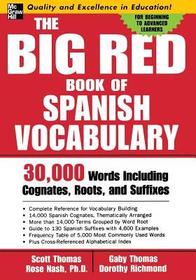
The Big Red Book of Spanish Vocabulary
30,000 Words through Cognates, Roots, and Suffixes
Series: NTC FOREIGN LANGUAGE;
- Publisher's listprice GBP 49.99
-
22 570 Ft (21 495 Ft + 5% VAT)
The price is estimated because at the time of ordering we do not know what conversion rates will apply to HUF / product currency when the book arrives. In case HUF is weaker, the price increases slightly, in case HUF is stronger, the price goes lower slightly.
- Discount 10% (cc. 2 257 Ft off)
- Discounted price 20 313 Ft (19 346 Ft + 5% VAT)
Subcribe now and take benefit of a favourable price.
Subscribe
22 570 Ft

Availability
printed on demand
Why don't you give exact delivery time?
Delivery time is estimated on our previous experiences. We give estimations only, because we order from outside Hungary, and the delivery time mainly depends on how quickly the publisher supplies the book. Faster or slower deliveries both happen, but we do our best to supply as quickly as possible.
Product details:
- Publisher McGraw Hill
- Date of Publication 16 October 2005
- ISBN 9780071447256
- Binding Paperback
- No. of pages640 pages
- Size 251x177x34 mm
- Weight 928 g
- Language English 0
Categories
Short description:
The easiest way to add more than 30,000 words to your Spanish vocabulary!
You know the basics of Spanish, but if you really want to develop your language skills, you need to have a larger cache of Spanish words that you are comfortable using in conversation or in writing. The Big Red Book of Spanish Vocabulary is a remarkably effective tool that will help you add thousands of words to your Spanish repertoire by organizing them into logical groupings, making memorization a snap.
The 30,000 Spanish vocabulary terms are divided into the following sections:
- Cognates: These words are similar in Spanish and English, making them the easiest to learn. This section contains 14,000 cognates thematically arranged into twenty key topics.
- Root families: Another easy way to expand your vocabulary is to become familiar with related word families that have the same root. This section contains 14,000 terms grouped into 2,200 root categories.
- Suffixes: More than most languages, Spanish relies on suffixes to denote parts of speech and convey nuances of meaning. This section contains 4,600 terms grouped into 130 of the most common Spanish suffixes.
The Big Red Book of Spanish Vocabulary also includes a Frequency Table listing the 5,000 most commonly used words in Spanish and an Alphabetical Index cross-referencing every entry in the root, suffix, and frequency sections.
Whether for school, business, travel, or just for fun, The Big Red Book of Spanish Vocabulary will give you the major boost in vocab you need!
MoreLong description:
Vocabulary forms the building blocks of language learning, and it is essential for learners to expand their vocabulary – whether for active communication, or passive oral understanding or written comprehension. However, most existing vocabulary books don’t provide any assistance in actually learning and assimilating the words – the student might as well just look words up in a dictionary.
In answer to this need, The Big Red Book of Spanish Vocabulary is a unique reference that provides students with a tremendous resource by combining three key, complementary approaches to vocabulary building:
• Cognates: the easiest way to build vocabulary – by learning words in Spanish that are similar to the English meaning. This section contains 14,000 cognates thematically arranged into 20 thematic groups, which are further divided into 100 topics.
• Root families: another key way to expand vocabulary is to learn related word families that have the same root. This section contains 14,000 terms grouped by 2,200 root categories. The headwords (the most commonly used word in the family) are ordered alphabetically.
• Suffixes: more than most languages, Spanish relies on suffixes to denote parts of speech and convey nuances of meaning. This section contains 130 of the most common Spanish suffixes, grouped alphabetically. The meaning of each suffix is explained, and then exemplified by an illustrative list of words taking the suffix (4,000 words in all), their English equivalent, and the stem to which it is related.
These three sections are complimented by a Frequency Index that lists the 5,000 most frequently used words in Spanish. The 1,000 most commonly used words are illustrated by example sentences that provide contextual usage. This index is cross-referenced to the Cognate, Root and Suffix sections.
In addition, an Alphabetical Index cross-references all the entries in the Root, Suffix and Frequency sections.
Vocabulary forms the building blocks of language learning, and it is essential for learners to expand their vocabulary – whether for active communication, or passive oral understanding or written comprehension. However, most existing vocabulary books don’t provide any assistance in actually learning and assimilating the words – the student might as well just look words up in a dictionary.
In answer to this need, The Big Red Book of Spanish Vocabulary is a unique reference that provides students with a tremendous resource by combining three key, complementary approaches to vocabulary building:
• Cognates: the easiest way to build vocabulary – by learning words in Spanish that are similar to the English meaning. This section contains 14,000 cognates thematically arranged into 20 thematic groups, which are further divided into 100 topics.
• Root families: another key way to expand vocabulary is to learn related word families that have the same root. This section contains 14,000 terms grouped by 2,200 root categories. The headwords (the most commonly used word in the family) are ordered alphabetically.
• Suffixes: more than most languages, Spanish relies on suffixes to denote parts of speech and convey nuances of meaning. This section contains 130 of the most common Spanish suffixes, grouped alphabetically. The meaning of each suffix is explained, and then exemplified by an illustrative list of words taking the suffix (4,000 words in all), their English equivalent, and the stem to which it is related.
These three sections are complimented by a Frequency Index that lists the 5,000 most frequently used words in Spanish. The 1,000 most commonly used words are illustrated by example sentences that provide contextual usage. This index is cross-referenced to the Cognate, Root and Suffix sections.
In addition, an Alphabetical Index cross-references all the entries in the Root, Suffix and Frequency sections.
MoreTable of Contents:
Acknowledgments Using This Vocabulary Book
Explanation of how to use the dictionaries in this book
Abbrevaitions and Grammatical Notes
Thesaurus of Spanish Cognates
Thematically-ordered lists of 14,000 English-Spanish Cognates The Wide World of WordsEveryday VocabularyDictionariesBooks and LibrariesJournalismLiterature
Pleasures and Pastimes
EntertainmentSportsGamesTelevison and VideoMovies PhotographyAmateur RadioPersonal ComputersTravel and Tourism
The Arts
Art and Aesthetics
Music
Dancing
Theater Performance
Visual Arts
Architecture
Knowledge, Faith, and the Paranormal
Philosphy
Religion
MagicDaily Living
The City
Home Furnishings
Food and Nutrition
Beverages
Automobiles
Work
Keeping the Body Beautiful
Clothing
Cosmetics and Grooming
Gems and Jewelry
The Inner Self
Feelings and Emotins
Character Traits
Sense Impressions
Actions and Actors
Experiences Forms of Address
Personal Names
Titles
Roles and Relationships
Society and Culture
Family
Education
Organizations and Meetings
Sociology
Anthropology
Affairs of StateLaw
The military establishment
Politics and Government
Buying and Selling
Economics
Business
Money and Finance
Transportation
Aviation and Spance Travel
Boats and Ships
Land Transportation
Living Things Great and Small
plants
aniamals
biology
Medical Matters
The Human body
Medical practice
Physical Disorders
Drugs
Death
Age and Aging
Understanding Our Universe
Science and the Sciences
Mathematics
Physics
Chemistry
Meterology
Putting Science to Work
Technology
Agriculture
Communications
Electricity and Electionics
Textiles
Quantification
Measurment
Time
Size and Degree
Counting and Arrangement
All About Language
Liguistics
Phonology
Grammar
Writing
Using Language
Languages of the World
Our Planet and Its peoplesGeography
Place names: Physical
Place names: political
Common False Cognates
Dictionary of Spanish Roots
Guide to Spanish Suffies
Spanish Frequency Table
Alaphabetical Index

