

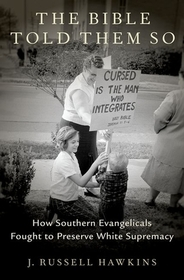
The Bible Told Them So
How Southern Evangelicals Fought to Preserve White Supremacy
- Publisher's listprice GBP 25.49
-
12 177 Ft (11 597 Ft + 5% VAT)
The price is estimated because at the time of ordering we do not know what conversion rates will apply to HUF / product currency when the book arrives. In case HUF is weaker, the price increases slightly, in case HUF is stronger, the price goes lower slightly.
- Discount 10% (cc. 1 218 Ft off)
- Discounted price 10 959 Ft (10 437 Ft + 5% VAT)
Subcribe now and take benefit of a favourable price.
Subscribe
12 177 Ft

Availability
printed on demand
Why don't you give exact delivery time?
Delivery time is estimated on our previous experiences. We give estimations only, because we order from outside Hungary, and the delivery time mainly depends on how quickly the publisher supplies the book. Faster or slower deliveries both happen, but we do our best to supply as quickly as possible.
Product details:
- Publisher OUP USA
- Date of Publication 7 September 2021
- ISBN 9780197571064
- Binding Hardback
- No. of pages224 pages
- Size 236x163x20 mm
- Weight 454 g
- Language English 144
Categories
Short description:
Why did southern white evangelical Christians resist the civil rights movement in the 1950s and 1960s? Simply put, they believed the Bible told them so. When the civil rights movement ultimately triumphed in the 1960s, it fundamentally changed southern society. But it didn't change white evangelicalism. Instead, the segregationist Christianity that fought against the civil rights movement lived on after the movement's success. Turning their attention to institutions they still controlled--churches, denominations, homes, and private high schools--white evangelicals continued to preach and practice segregationist Christianity, disguising it in language of colorblindness and family protection.
MoreLong description:
Why did southern white evangelical Christians resist the civil rights movement in the 1950s and 1960s? Simply put, they believed the Bible told them so. These white Christians entered the battle certain that God was on their side. Ultimately, the civil rights movement triumphed in the 1960s and, with its success, fundamentally transformed American society. But this victory did little to change southern white evangelicals' theological commitment to segregation. Rather than abandoning their segregationist theology in the second half of the 1960s, white evangelicals turned their focus on institutions they still controlled--churches, homes, denominations, and private colleges and secondary schools--and fought on.
Focusing on the case of South Carolina, The Bible Told Them So shows how, despite suffering defeat in the public sphere, white evangelicals continued to battle for their own institutions, preaching and practicing a segregationist Christianity they continued to believe reflected God's will. Increasingly caught in the tension between their sincere belief that God desired segregation and their reluctance to give voice to such ideas for fear of being perceived as bigoted or intolerant, by the late 1960s southern white evangelicals embraced the rhetoric of colorblindness and protection of the family as measures to maintain both segregation and respectable social standing. This strategy set southern white evangelicals on an alternative path for race relations in the decades ahead.
This book is an excellent beginning to confronting these ghosts of our past that still haunt our pursuits of racial justice. Anyone with an interest in the history of race in the United States -- particularly as it connects to religion -- will learn a great deal from this book. It is well-suited for a variety of courses in the sociology or history of religion, as well as for seminary courses.
Table of Contents:
Acknowledgments
Introduction: "As Old as the Scriptures"
Chapter One: Not in Our Church: Congregational Backlash to Brown v. Board of Education
Chapter Two: The Bounds of Their Habitation: The Theological Foundation of Segregationist Christianity
Chapter Three: Jim Crow on Christian Campuses: The Desegregation of Furman and Wofford
Chapter Four: Embracing Colorblindness: The Methodist Merger and the Transformation of Segregationist Christianity
Chapter Five: Focusing on the Family: Private Schools and the New Shape of Segregationist Christianity
Epilogue: The Heirs of Segregationist Christianity
Index

