

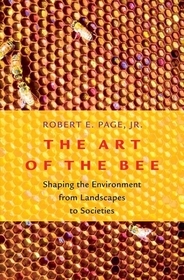
The Art of the Bee
Shaping the Environment from Landscapes to Societies
- Publisher's listprice GBP 31.99
-
14 443 Ft (13 755 Ft + 5% VAT)
The price is estimated because at the time of ordering we do not know what conversion rates will apply to HUF / product currency when the book arrives. In case HUF is weaker, the price increases slightly, in case HUF is stronger, the price goes lower slightly.
- Discount 10% (cc. 1 444 Ft off)
- Discounted price 12 998 Ft (12 380 Ft + 5% VAT)
Subcribe now and take benefit of a favourable price.
Subscribe
14 443 Ft

Availability
printed on demand
Why don't you give exact delivery time?
Delivery time is estimated on our previous experiences. We give estimations only, because we order from outside Hungary, and the delivery time mainly depends on how quickly the publisher supplies the book. Faster or slower deliveries both happen, but we do our best to supply as quickly as possible.
Product details:
- Publisher OUP USA
- Date of Publication 17 September 2020
- ISBN 9780197504147
- Binding Hardback
- No. of pages256 pages
- Size 236x163x20 mm
- Weight 499 g
- Language English 38
Categories
Short description:
This book combines biological information with sociological and philosophical frameworks to draw connections between the sociability of bees and their relation to humans.
MoreLong description:
The impact of bees on our world is immeasurable. Bees are responsible for the evolution of the vast array of brightly colored flowers and for engineering the niches of multitudes of plants, animals, and microbes. They've painted our landscapes with flowers through their pollination activities, and they have evolved the most complex societies to aid their exploitation of the environment.
The parallels between human and insect societies have been explored by countless sociobiologists. Traditional texts present stratified layers of knowledge where the reader excavates levels of biological organization, each building on the last. In this book, Robert E. Page, Jr., delves deep into the evolutionary history and the sociality of bees. He presents fundamental biology-not in layers, but wrapped around interesting themes and concepts, and in ways designed to explore and understand each concept. Page uses the social contract as a way to examine the complex social system of bee societies, a contract that has been written over millions of years of social evolution on the fabric of DNA. The book examines the coevolution of bees and flowering plants, bees as engineers of the environment, the evolution of sociality, the honey bee as a superorganism and how it evolves, and the mating behavior of the queen. The resulting book explores the ways human societies and bee colonies are similar-not from a common ancestry with shared genes for sociality, but from shared fundamentals of political philosophy.
[I] recommend this wonderful volume unreservedly to students of bee biology, naturalists, gardeners, and anyone with a desire to know more about the fascinating world of honey bees.
Table of Contents:
Preface
Chapter 1: Environmental Artists
Chapter 2: How Bees "Paint" Their Local Environment
Chapter 3: Environmental Engineering
Chapter 4: The Social Contract
Chapter 5: The Superorganism
Chapter 6: Reproductive Competition
Chapter 7: How to Make a Superorganism
Chapter 8: How a Superorganism Evolves
Chapter 9: The Song of the Queen
Epilogue
Resources
Index

