

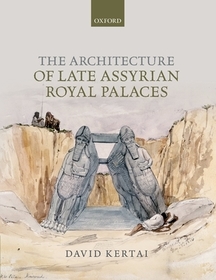
The Architecture of Late Assyrian Royal Palaces
- Publisher's listprice GBP 157.50
-
71 111 Ft (67 725 Ft + 5% VAT)
The price is estimated because at the time of ordering we do not know what conversion rates will apply to HUF / product currency when the book arrives. In case HUF is weaker, the price increases slightly, in case HUF is stronger, the price goes lower slightly.
- Discount 10% (cc. 7 111 Ft off)
- Discounted price 64 000 Ft (60 953 Ft + 5% VAT)
Subcribe now and take benefit of a favourable price.
Subscribe
71 111 Ft

Availability
printed on demand
Why don't you give exact delivery time?
Delivery time is estimated on our previous experiences. We give estimations only, because we order from outside Hungary, and the delivery time mainly depends on how quickly the publisher supplies the book. Faster or slower deliveries both happen, but we do our best to supply as quickly as possible.
Product details:
- Publisher OUP Oxford
- Date of Publication 26 March 2015
- ISBN 9780198723189
- Binding Hardback
- No. of pages304 pages
- Size 253x195x25 mm
- Weight 832 g
- Language English
- Illustrations 97 illustrations, including 24 colour plates 0
Categories
Short description:
The Architecture of Late Assyrian Royal Palaces is the first volume to provide an in-depth analysis of Late Assyrian palatial architecture, offering a general introduction to all key royal palaces in the major centres of the empire: Assur, Kalḫu, Dur-Sharruken, and Nineveh.
MoreLong description:
The Late Assyrian Empire (c. 900 - 612 BCE) was the first state to rule over the major centres of the Middle East, and the Late Assyrian court inhabited some of the most monumental palaces of its time. The Architecture of Late Assyrian Royal Palaces is the first volume to provide an in-depth analysis of Late Assyrian palatial architecture, offering a general introduction to all key royal palaces in the major centres of the empire: Assur, Kalḫu, Dur-Sharruken, and Nineveh.
Where previous research has often focused on the duality between public and private realms, this volume redefines the cultural principles governing these palaces and proposes a new historical framework, analysing the spatial organization of the palace community which placed the king front and centre. It brings together the architecture of such palaces as currently understood within the broader framework of textual and art-historical sources, and argues that architectural changes were guided by a need to accommodate ever larger groups as the empire grew in size.
Kertai's emphasis is on the spatial organisation of the palace community rather than the dichotomy of the public and private realms and rights of access. High-quality plans.
Table of Contents:
Acknowledgements
List of Plates and Figures
Plans by Author
Abbreviations
Introduction
Ashurnasirpal II (883-859)
Shalmaneser III (858-824)
Adad-nerari III (810-783), Tiglath-pileser III (744-727) and the Interceding Decades
Sargon II (722-705)
Sennacherib (704-681)
Esarhaddon (681-669)
Ashurbanipal (668-631)
Palatial Spaces
Palatial Suites
250 Years of Late Assyrian Palaces
Appendix
Bibliography

