

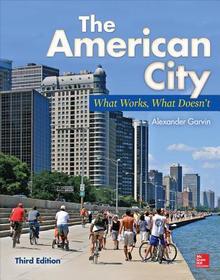
The American City: What Works, What Doesn't
What Works, What Doesn't
Series: P/L CUSTOM SCORING SURVEY;
- Publisher's listprice GBP 77.99
-
37 259 Ft (35 485 Ft + 5% VAT)
The price is estimated because at the time of ordering we do not know what conversion rates will apply to HUF / product currency when the book arrives. In case HUF is weaker, the price increases slightly, in case HUF is stronger, the price goes lower slightly.
- Discount 10% (cc. 3 726 Ft off)
- Discounted price 33 533 Ft (31 937 Ft + 5% VAT)
Subcribe now and take benefit of a favourable price.
Subscribe
37 259 Ft

Availability
printed on demand
Why don't you give exact delivery time?
Delivery time is estimated on our previous experiences. We give estimations only, because we order from outside Hungary, and the delivery time mainly depends on how quickly the publisher supplies the book. Faster or slower deliveries both happen, but we do our best to supply as quickly as possible.
Product details:
- Edition number 3
- Publisher McGraw Hill
- Date of Publication 16 November 2013
- ISBN 9780071801621
- Binding Hardback
- No. of pages640 pages
- Size 281x223x43 mm
- Weight 2586 g
- Language English 0
Categories
Short description:
Now in full color—an updated edition of THE standard reference work on urban planning and design
MoreLong description:
Publisher's Note: Products purchased from Third Party sellers are not guaranteed by the publisher for quality, authenticity, or access to any online entitlements included with the product.
The definitive guide to urban planning and design--completely updated and now in full color
In the Third Edition of The American City: What Works, What Doesn't, award-winning city planner and renowned urban scholar Alexander Garvin examines more than 350 programs and projects that have been implemented nationwide in 150 cities and suburbs, evaluates their successes and failures, and offers relevant lessons learnedfrom them.
Nearly all of the book's 650 illustrations are now in full color and consist almost entirely of photographs, maps, and diagrams produced especially for the Third Edition. Garvin discusses major urban initiatives that have emerged over the past two decades, such as Chicago's Millennium Park, Houston's Uptown Business District, and Metropolitan Denver's FasTracks multicounty rapid transitnetwork. He reexamines the wide range of places and strategies covered in the previous edition, offering new analyses and insights. A new chapter on retrofitting the city for a modern commercial economy is included.
This practical guide presents six key ingredients of project success--market, location, design, financing, time, and entrepreneurship--and explains how to combine these elements in a mutually reinforcing manner. Garvin demonstrates how the synthesis of individual and private-sector efforts, community-level action, and broad-based government policy can--and has--achieved urban and suburban regeneration.
COVERAGE INCLUDES:
- A realistic approach to city and suburban planning
- Ingredients of success--market, location, design, financing, time, and entrepreneurship
- Parks, playgrounds, and open space
- Retail shopping
- Palaces for the people--libraries, stadiums, museums, and other public facilities
- Retrofitting the city for a modern commercial economy
- The life and death of the City of Tomorrow--implications of national urban redevelopment programs
- Downtown management
- Increasing the housing supply
- Reducing housing costs
- Housing rehabilitation
- Clearing the slums
- Revitalizing neighborhoods
- Residential suburbs
- New-towns-in-town
- New-towns-in-the-country
- Land use regulation
- Historic preservation
- Comprehensive planning
Publisher's Note: Products purchased from Third Party sellers are not guaranteed by the publisher for quality, authenticity, or access to any online entitlements included with the product.
The definitive guide to urban planning and design--completely updated and now in full color
In the Third Edition of The American City: What Works, What Doesn't, award-winning city planner and renowned urban scholar Alexander Garvin examines more than 350 programs and projects that have been implemented nationwide in 150 cities and suburbs, evaluates their successes and failures, and offers relevant lessons learnedfrom them.
Nearly all of the book's 650 illustrations are now in full color and consist almost entirely of photographs, maps, and diagrams produced especially for the Third Edition. Garvin discusses major urban initiatives that have emerged over the past two decades, such as Chicago's Millennium Park, Houston's Uptown Business District, and Metropolitan Denver's FasTracks multicounty rapid transitnetwork. He reexamines the wide range of places and strategies covered in the previous edition, offering new analyses and insights. A new chapter on retrofitting the city for a modern commercial economy is included.
This practical guide presents six key ingredients of project success--market, location, design, financing, time, and entrepreneurship--and explains how to combine these elements in a mutually reinforcing manner. Garvin demonstrates how the synthesis of individual and private-sector efforts, community-level action, and broad-based government policy can--and has--achieved urban and suburban regeneration.
COVERAGE INCLUDES:
- A realistic approach to city and suburban planning
- Ingredients of success--market, location, design, financing, time, and entrepreneurship
- Parks, playgrounds, and open space
- Retail shopping
- Palaces for the people--libraries, stadiums, museums, and other public facilities
- Retrofitting the city for a modern commercial economy
- The life and death of the City of Tomorrow--implications of national urban redevelopment programs
- Downtown management
- Increasing the housing supply
- Reducing housing costs
- Housing rehabilitation
- Clearing the slums
- Revitalizing neighborhoods
- Residential suburbs
- New-towns-in-town
- New-towns-in-the-country
- Land use regulation
- Historic preservation
- Comprehensive planning
Table of Contents:
Ch. 1 A Realistic Approach; Ch. 2. Ingredients of Success; Ch. 3. Parks; Downtown Strategies (new); Ch. 4. Retailing; Ch. 5. Magnets; Ch. 6. Modernization; Ch. 7. Retrofitting for Vehicles; Ch. 8. Reclaiming Public Realm; Ch. 9. Downtown Management; Housing Strategies (new); Ch. 10. Increasing Housing; Ch. 11. Reducing Cost; Ch. 12. Housing Rehab; Ch. 13. Clearing Slums; Ch. 14. Revitalizing Neighborhoods; Suburban Strategies (new); Ch. 15. Residential Suburbs; Ch. 16. New Enclaves; Ch. 17. New Towns; Regulatory Strategies (new); Ch. 18. Land Use Regulations; Ch. 19. Historic Preservation; Ch. 20. Comprehensive Planning; Index
More
